
Fire Safety in High-Rise Buildings: What Residents Should Know in India
Founder, Speciality Geochem
Quick answer: In a high-rise fire, use the stairs and never the lift. If the fire is in your flat, get everyone out, close the door behind you and raise the alarm. If the corridor is full of smoke, stay inside, seal the door gaps with wet towels and call 101 or 112. Know your two staircases and refuge floor in advance.
Key takeaways
- In India, NBC 2016 treats a building 15 metres or taller as a high-rise, which works out to about five floors or more.
- Lifts can stop between floors or open onto a burning floor, so use them only if firefighters direct you to.
- Fire doors on staircases must close by themselves. A door wedged open lets smoke into the only escape route.
- Electrical shafts used as storerooms are a common cause of fires spreading between floors.
- Every resident should know both staircases, the refuge area and the assembly point.
Why are high-rise fires different?
In a bungalow you can step out of the front door. In a 14th-floor flat, the way out is a staircase shared by hundreds of people. Ladders on most fire tenders reach only part of the way up a tall building. So residents depend on the building’s own systems and on knowing what to do.
Smoke is the main danger. It rises through staircases, lift shafts and electrical ducts and can reach floors far above the fire within minutes. Most deaths in building fires come from smoke, not flames. Thick smoke also hides exit signs and makes a familiar corridor feel like a maze, which is why practising the route matters.
The National Building Code of India 2016, Part 4, lays down fire systems for high-rise buildings, including sprinklers, alarms, risers, pressurised staircases, fire lifts and refuge areas. Your society is responsible for keeping them working.
What should you do in a high-rise fire?
Your choice depends on where the fire is.
If the fire is in your flat:
- Shout to alert everyone and get out at once. Do not stop to collect valuables.
- Close the flat door behind you to hold the fire and smoke inside.
- Press the nearest fire alarm call point, if there is one, on your way out.
- Use the staircase, never the lift.
- Call 101 or 112 once you are safe and tell them the floor and flat number.
If the fire is on another floor and the corridor is smoky:
- Stay inside and close all doors between you and the corridor.
- Seal gaps under the door with wet towels or bedsheets.
- Call 101 or 112 and give your exact flat number.
- Go to a balcony or a window away from the smoke and signal with a cloth or torch.
If the corridor is clear, leave calmly by the staircase and go to the assembly point. Our step-by-step emergency plan for a fire at home covers the steps inside the flat in more detail.
Which building fire systems should residents know about?
| System | What it does | What residents should check |
|---|---|---|
| Staircase fire doors | Keep smoke out of the staircase | They close by themselves and are never wedged open |
| Refuge area | Safe waiting floor in taller towers | You know which floor it is and it is not used for storage |
| Sprinklers and smoke detectors | Detect and control fire early | Not painted over, blocked by false ceilings or removed during renovation |
| Wet riser / hose reel | Water for firefighters on each floor | Cabinet not locked shut or used as a store |
| Fire lift | Lift for firefighters only | Residents know it is not an escape lift |
| Fire alarm and PA system | Warns all floors | Tested during society drills |
What are the common fire risks in Indian high-rise apartments?
- Electrical shafts and meter rooms filled with old furniture, paint tins and cartons.
- Staircase landings used to park cycles, shoe racks and plant pots.
- AC outdoor units in balconies collecting dust and dry leaves, with loose wiring.
- Diyas, candles and crackers on balconies, where sparks can land on lower floors or on AC units.
- E-scooters charged in lobbies or near the lift.
Inside your own flat, keep one extinguisher where you can reach it on the way out. Our guide on where to keep a fire extinguisher at home shows the best spots in a flat.
What should your society or RWA do?
Ask your RWA for a yearly fire drill, a written evacuation plan posted at every lift lobby, and a monthly test of the fire pump and alarm. The fire NOC must stay valid, and a fire safety agency should service the systems. Make sure the guards on every shift know how to start the fire pump and use the PA system. If you are on the managing committee and need help with equipment for common areas, talk to our team.
When not to fight the fire: if the fire is bigger than a small bin, the room is filling with smoke, or you cannot see the exit, leave at once and call 101 or 112. Never go back inside.
For home safety checks room by room, see our home fire safety guide.
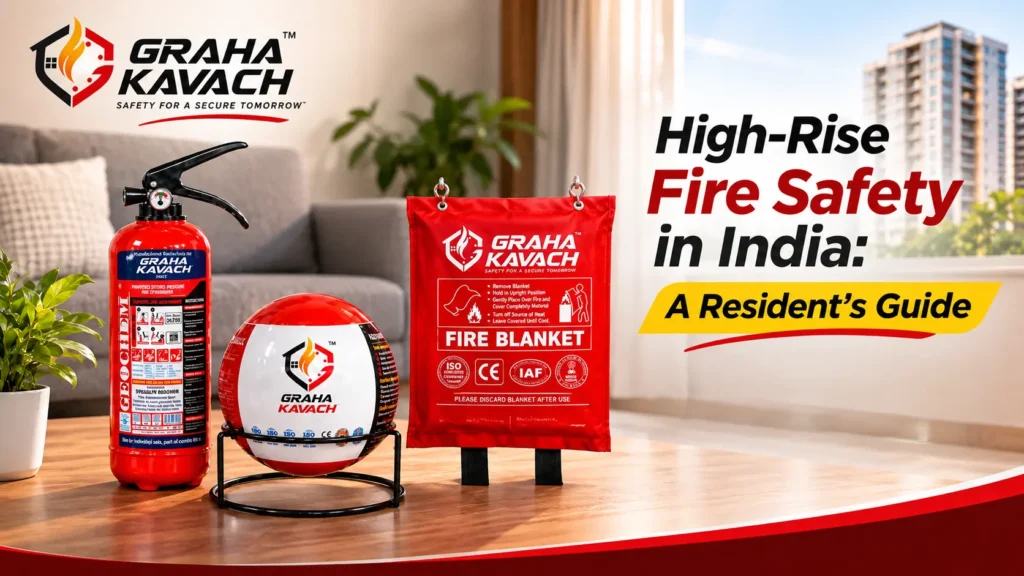
Keep your flat ready: The Graha Kavach 3-in-1 Fire Safety Kit gives you a 2 kg ABC extinguisher, an automatic fire ball for the kitchen or panel area, and a fire blanket, with free delivery across India. Graha Kavach, by Speciality Geochem, Udaipur (since 2010).
Frequently Asked Questions
Q1. Should I use the lift during a fire in a high-rise?
No. Lifts can fail, stop between floors or open onto the fire floor. Always use the staircase unless firefighters tell you to use the fire lift.
Q2. Is it safer to stay in my flat or leave during a high-rise fire?
Leave if the fire is in your flat or the corridor is clear. If the corridor is full of smoke, stay inside, seal the door gaps, call 101 or 112 and signal from a window.
Q3. What is a refuge area in a building?
A refuge area is a fire-protected open space on selected floors of tall buildings. Residents who cannot reach the ground can wait there safely for rescue.
Q4. What height is considered a high-rise building in India?
Under NBC 2016, a building 15 metres or more in height is a high-rise. That is usually about five floors or more, depending on floor height.
Q5. Why should staircase fire doors stay closed?
They keep smoke out of the staircase so it stays usable for escape. A door wedged open with a brick or a shoe rack lets smoke fill the only way down.
Q6. How do I stop smoke coming into my flat?
Close every door, seal gaps under the main door with wet towels, and switch off ACs that pull in air from outside. Stay near a window or balcony away from the smoke.
Q7. How often should a housing society hold fire drills?
At least once a year, with notice to all residents. Larger towers often run drills more often, and test the alarm and fire pump every month.
Q8. Do I need a fire extinguisher if my building has sprinklers?
Yes. Sprinklers protect the building, but a fire inside your flat may start in a spot they do not reach quickly. A home extinguisher lets you stop a small fire in the first few seconds.
Q9. What should I keep ready for an emergency in a high-rise flat?
Keep a torch, a wet towel within reach, your phone, and a small fire extinguisher near the main door. Make sure every family member knows both staircases and the assembly point.
Verified Technical Direction
This guide was prepared in accordance with official Indian fire safety standards, chemical specifications from Speciality Geochem Udaipur, and the Graha Kavach Home Safety Manual. Always adhere to evacuation-first principles in an active fire.
Equip Your Home with Graha Kavach
Get the complete 3-in-1 kit: 2kg ABC Extinguisher, Automatic Fire Ball, and 550°C Fire Blanket for ₹2,499.
Related Safety Articles
LPG Cylinder Fire Safety at Home: Prevention & What to Do in an Emergency
Quick answer: If an LPG cylinder catches fire at the regulator or hose, protect your hand with a wet cloth and turn the regulator knob to OFF. A small flame usually dies once the gas stops. If you cannot reach the knob, or the fire is spreading, get everyone out and call 101 or 112. […]
Lithium Battery Fires at Home: Phones, Laptops, E-Bikes & EV Charging
Quick answer: To prevent a lithium battery fire at home, charge devices with their original charger, on a hard surface, and never overnight under a pillow or in a closed room. Charge e-scooters outside the flat, away from the exit. Stop using any battery that swells, gets very hot or smells sweet. If one catches […]

What Is a Fireproof Blanket? Material, Size & Fire Rating Explained
Quick answer: A fireproof blanket is a sheet of woven fire-resistant fabric, usually fibreglass, that puts out a small fire by cutting off its oxygen. Home blankets are commonly 1 m × 1 m. No blanket is truly “fireproof”; a good one resists flame and heat long enough to smother a pan or clothing fire […]