
Lithium Battery Fires at Home: Phones, Laptops, E-Bikes & EV Charging
Founder, Speciality Geochem
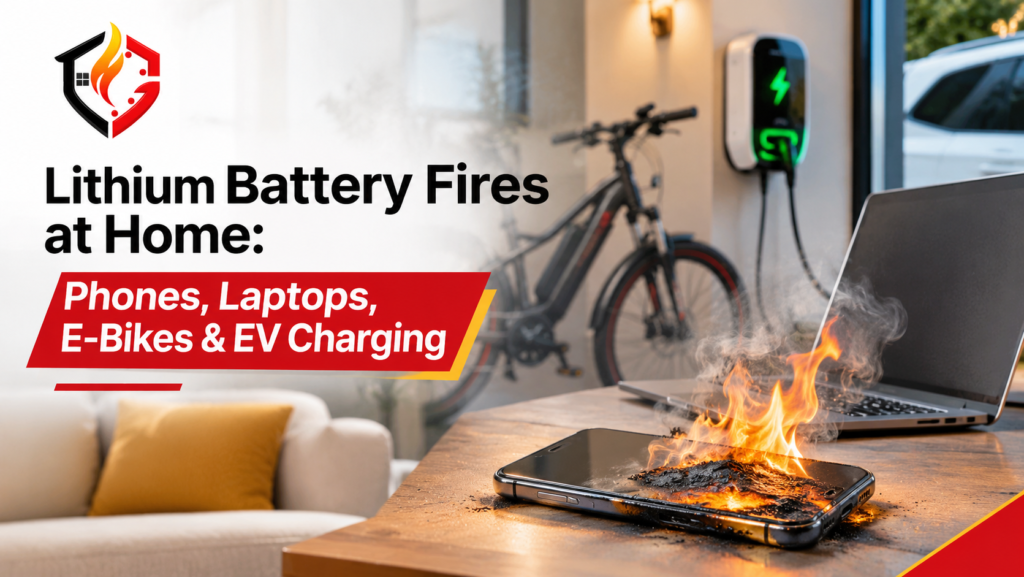
Quick answer: To prevent a lithium battery fire at home, charge devices with their original charger, on a hard surface, and never overnight under a pillow or in a closed room. Charge e-scooters outside the flat, away from the exit. Stop using any battery that swells, gets very hot or smells sweet. If one catches fire, get everyone out and call 101 or 112.
Key takeaways
- Phones, laptops, power banks, e-scooters and e-bikes all use lithium-ion cells that can overheat and catch fire.
- A swollen, hot or hissing battery is a warning sign. Stop charging it at once.
- E-scooter batteries hold far more energy than a phone, so their fires grow fast and give off toxic smoke.
- MoRTH added stricter battery safety tests for electric two-wheelers through amendments to AIS-156 in 2022.
- A home extinguisher can stop flames spreading to curtains and furniture, but it cannot cool a burning battery pack.
Why do lithium batteries catch fire?
A lithium-ion battery stores a lot of energy in a small space. When a cell is damaged, overcharged or overheated, it can enter “thermal runaway.” The cell heats itself, releases flammable gas and passes the heat to the next cell. The fire can flare, die down and flare again.
In Indian homes, the usual triggers are simple. People buy a ₹150 roadside charger, leave a phone charging under a pillow, or keep a power bank on the car dashboard in May. E-scooters get charged in the living room on an extension board. Each of these can push a cell past its safe limit.
Which devices are most at risk, and what are the warning signs?
| Device | Warning signs | Safe charging habit |
|---|---|---|
| Mobile phone | Back panel lifting, phone hot while idle | Original charger, on a table, not on the bed |
| Laptop | Trackpad pushed up, fan running hot | Hard surface, never on a mattress or blanket |
| Power bank | Bulging case, warm when not in use | Buy branded, never leave in a parked car |
| E-scooter / e-bike | Hissing, smoke, burning or sweet smell, range drops suddenly | Outside the flat, original charger, not overnight |
| Electric car (home charger) | Charger cable or plug hot, tripping MCB | Licensed electrician, dedicated wall box |
If you notice any warning sign, unplug the charger at the wall switch. Move the device away from anything that can burn only if it is cool enough to hold, and do not use it again.
How do you charge e-bikes and e-scooters safely at home?
An e-scooter battery holds many times the energy of a phone. A fire in one can fill a 2BHK with thick smoke in minutes. Follow these steps every time:
- Charge outside the living space: in an open parking area, a ventilated balcony or a society charging point. Never block the main door or corridor.
- Use only the original charger. A cheaper charger may not cut off at full charge.
- Plug into a wall socket with its own MCB, never into an extension board running other appliances.
- Do not charge overnight or when no one is home. Unplug once it is full.
- Let the battery cool for 30 minutes after a ride before charging.
- Avoid local battery repairs that replace cells with unbranded ones.
When buying a new electric two-wheeler, ask the dealer whether it meets the latest battery rules. After a series of e-scooter fires, MoRTH issued Amendment 2 to AIS-156, adding tests for cells, the battery management system, the charger and thermal propagation. It came into force in two phases, in December 2022 and March 2023.
What about EV charging in a housing society?
If you charge an electric car in a basement or stilt parking, get the wall charger installed by a licensed electrician on a dedicated circuit. Keep the area clear of stored cartons, old furniture and spare tyres. Ask your RWA for a marked power cut-off switch near the charging point and a smoke detector above it.
What should you do if a lithium battery catches fire?
- Small device, just started smoking: if it is safe, switch off the wall socket. Do not pick up the device. Keep children and pets away.
- Flames spreading to bedding, curtains or a sofa: use your extinguisher on the burning furniture, aiming at the base of the flames.
- E-scooter or large battery on fire: do not try to fight it. Get everyone out, close the door behind you and call 101 or 112. Tell them it is a lithium battery.
A 2 kg ABC fire extinguisher for home handles the burning things around the battery, but not the battery pack itself. Our guide on which extinguisher to use on an electrical fire explains why ABC suits most home fires. For the full escape routine, follow our step-by-step emergency plan for a fire at home.
When not to fight the fire: if smoke is thick, the battery keeps flaring, or the fire is larger than a small bin, leave the room, close the door and call 101 or 112 from outside.
What simple habits reduce the risk every day?
- Never charge a phone under a pillow or on the bed.
- Buy chargers and power banks that carry the BIS mark.
- Store spare batteries in a cool, dry drawer, away from keys and coins.
- Throw away swollen batteries at an e-waste collection point, not in the dustbin.
- Keep one smoke detector in the room where e-scooters or laptops are charged.
For more room-by-room checks, see our home fire safety guide.
Be ready before a fire starts: The Graha Kavach 3-in-1 Fire Safety Kit has a 2 kg ABC extinguisher with a pressure gauge, an automatic fire ball and a 1 m × 1 m fibreglass fire blanket, with free delivery across India. Graha Kavach, by Speciality Geochem, Udaipur (since 2010).
Frequently Asked Questions
Q1. Can a phone battery catch fire while charging?
Yes, though it is rare with original chargers. Risk rises with cheap chargers, a damaged phone, or charging under a pillow where heat cannot escape. Charge on a hard surface and unplug once full.
Q2. Is it safe to charge an e-scooter inside the house?
It is safer to charge it outside the living space, in a ventilated area away from exits. Never charge it overnight unattended or on an extension board.
Q3. What does a swollen battery mean?
A swollen battery has gas building up inside a damaged cell. Stop using and charging it right away. Do not press or puncture it, and take it to an authorised service centre or e-waste point.
Q4. Can water put out a lithium battery fire?
Fire services use large amounts of water to cool battery packs, but at home your safety comes first. For anything bigger than a small device, leave, close the door and call 101 or 112.
Q5. Which fire extinguisher should I keep for battery fires at home?
Keep a 2 kg ABC extinguisher to stop flames spreading to furniture, curtains and wiring. No home extinguisher reliably stops a burning e-scooter battery, so escape comes first.
Q6. Why do e-bike batteries catch fire?
Common causes are mismatched chargers, overcharging, damage from falls or water, heat and cheap replacement cells. A fire can start while charging or soon after a long ride.
Q7. Can a power bank explode in a car?
A damaged or low-quality power bank can overheat in a parked car in summer, when cabin temperature rises sharply. Keep power banks with you, not on the dashboard.
Q8. How should I dispose of old lithium batteries?
Take them to an authorised e-waste collection point or the brand’s service centre. Do not throw them in household waste, where they can be crushed and catch fire.
Q9. Is it safe to charge a laptop on the bed?
No. A mattress or blanket blocks the vents and traps heat. Charge and use your laptop on a table or another hard surface.
Verified Technical Direction
This guide was prepared in accordance with official Indian fire safety standards, chemical specifications from Speciality Geochem Udaipur, and the Graha Kavach Home Safety Manual. Always adhere to evacuation-first principles in an active fire.
Equip Your Home with Graha Kavach
Get the complete 3-in-1 kit: 2kg ABC Extinguisher, Automatic Fire Ball, and 550°C Fire Blanket for ₹2,499.
Related Safety Articles

What Is a Fireproof Blanket? Material, Size & Fire Rating Explained
Quick answer: A fireproof blanket is a sheet of woven fire-resistant fabric, usually fibreglass, that puts out a small fire by cutting off its oxygen. Home blankets are commonly 1 m × 1 m. No blanket is truly “fireproof”; a good one resists flame and heat long enough to smother a pan or clothing fire […]
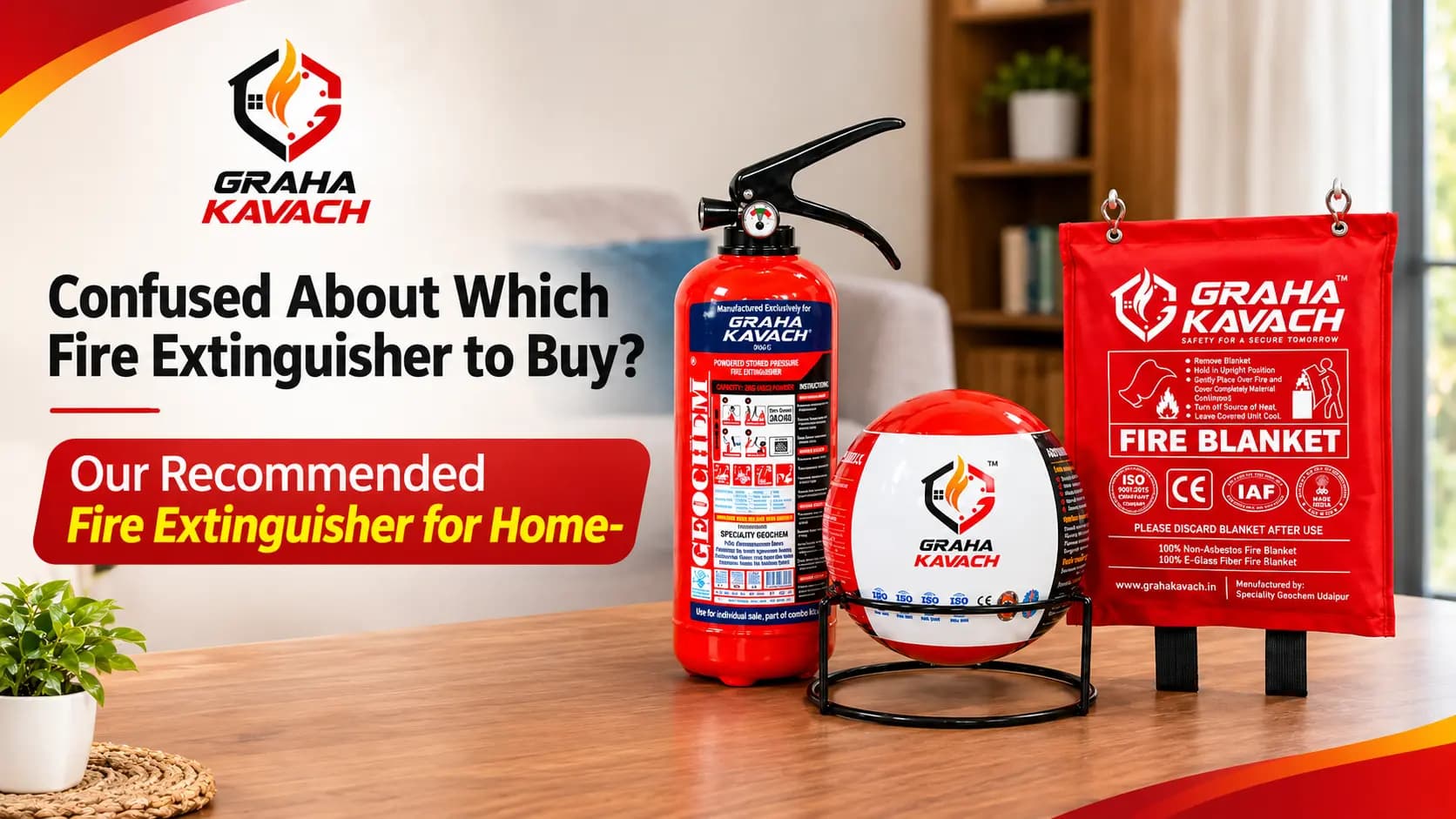
Recommended Fire Extinguisher for Home: Answer 4 Questions
“Which fire extinguisher should I buy?” is the question families ask us most often. Usually they have spent an evening comparing ABC, CO2 and foam listings, then closed the tab more confused than before. So try this instead. Don’t study every type. Answer four questions about your own home, and your answers will point to […]

Fire Extinguisher Cylinder Explained: Capacity, Weight & Right Size for a Home
Quick answer: A fire extinguisher cylinder is a pressurised steel container that holds an extinguishing agent, such as ABC dry powder. It pushes the agent out through a valve and nozzle when you squeeze the lever. Its “capacity” (1 kg, 2 kg, 4 kg and so on) is the weight of agent inside, not the […]