
What to Do in a Fire at Home: Step-by-Step Emergency Plan
Graha Kavach Fire Safety Team

When smoke appears, most people lose the first precious seconds deciding what to do. Should you grab the extinguisher, wake the children or call for help first? The answer is much easier when you have decided it in advance. This guide explains what to do in a fire at home in the order that matters, then helps you write a fire escape plan for your own family in about 15 minutes.
In one line: get people out first, call 101 or 112, and fight the fire only if it is small and your exit is clear behind you.
First, decide in 5 seconds: fight or leave?
Before you pick up any equipment, check these three things. Fight the fire only if all three are true. If even one is not true, leave at once.
- The fire is small- It is no bigger than a wastebasket and is not spreading fast.
- Your exit is clear- There is an open way out behind you, so the fire is never between you and the door.
- The right tool is within reach- An extinguisher, fire blanket or fire extinguisher ball is close enough to grab in seconds.
All three true? Have someone call 101 or 112, then fight the fire for a few seconds only. If it is not out quickly, leave.
Even one not true? Forget the fire and get everyone out. Belongings can be replaced. This quick check is the heart of knowing what to do in a fire, because staying to fight a fire that has grown is how people get hurt.
Fire emergency steps: when you decide to leave
These fire emergency steps are in the order you should follow them. Read them aloud to the family once, so nobody hears them for the first time during a real fire.
Step 1: Raise the alarm- Shout “Fire!” loudly and keep shouting as you move. Wake everyone, especially children, elders and anyone who sleeps heavily.
Step 2: Get everyone out- Do not stop to collect phones, jewellery or documents. Help children and elders first, and head for the nearest safe exit.
Step 3: Stay low under smoke- Smoke and heat rise, so the cleaner air is near the floor, roughly 30 to 60 cm up. Crawl on your hands and knees if the room is smoky, and cover your nose and mouth with cloth if you can.
Step 4: Check doors before opening them- Touch the door with the back of your hand. If it is hot, do not open it: use another way out. If it is cool, open it slowly and be ready to shut it again if smoke pushes in.
Step 5: Close doors behind you- A shut door holds back fire and smoke and buys time for anyone still inside and for the fire service.
Step 6: Use the stairs, never the lift- Lifts can stop between floors or open onto the fire floor.
Step 7: Call 101 or 112 from outside- Give your full address, a nearby landmark, the floor and whether anyone is still inside. Our fire safety guide keeps these numbers and the first-response steps on one page.
Step 8: Meet at your assembly point and count heads- Tell the fire service at once if anyone is missing.
Step 9: Never go back inside- Not for a pet, not for a phone, not to check. Wait for the fire service to say it is safe.
When you decide to fight: which tool and how
If all three answers were yes, have someone call 101 or 112 first, then use the tool that matches the fire and keep your exit at your back the whole time.
- 2 kg ABC fire extinguisher- Stand 3 to 4 metres away and use the PASS method: pull, aim, squeeze, sweep. It empties in about 10 to 12 seconds, so if the fire is not out by then, leave. Our PASS method guide shows each step.
- Fire blanket- For a burning pan, pull both tapes down, keep your hands behind the blanket, lay it over the pan from the front, then turn off the stove and the LPG regulator. Keep it there until the pan has fully cooled.
- Fire extinguisher ball- If one is mounted above the MCB panel, inverter or cylinder, it works by itself when flame reaches it. You can also use it by hand: stand 5 to 7 metres away and roll or toss it into the base of the fire.
Not sure which one fits which fire? Our comparison of the fire extinguisher, fire blanket and fire ball has a quick situation finder.
What to do in a fire: special situations
1. If someone’s clothes catch fire- Stop, drop and roll: stop moving, drop to the ground, cover the face with the hands and roll until the flames are out. Wrap the person in a fire blanket if one is close. Cool the burn with clean running water and get medical help.
2. If smoke or fire blocks your way out- Go into a room with a window and shut the door. Stuff towels, bedsheets or clothes into the gap under it. Call 101 or 112 and tell them exactly where you are, then signal from the window with a light or a bright cloth. Do not jump from upper floors.
3. If you must pass through heat- A fire blanket can protect you: wrap it around your shoulders, cover your head and hair, and move low under the smoke.
4. If you live in a flat- Know where the stairs are on your floor before you ever need them, and never use the lift during a fire alarm.
Make your fire escape plan in 15 minutes
Knowing what to do in a fire is only half the job. The other half is making sure everyone at home knows it too. Sit down with the family and fill in this fire escape plan together; it also becomes the script for what to do in a fire when someone is home alone.
| Part of the plan | What to write down |
|---|---|
| Main exit | The route from each bedroom to the front door |
| Second exit | A different way out of each room, in case the first is blocked |
| Assembly point | One fixed spot outside, such as the building gate or a neighbour’s house |
| Who helps whom | Which adult helps each child, elder or person who needs support |
| Emergency numbers | 101 for fire and 112 for any emergency, saved in every phone |
| House keys | One fixed place near the main door that everyone knows |
| Equipment | Where the extinguisher, fire blanket and fire ball for home are kept |
Draw a simple map of your home with both exits marked and stick it inside a cupboard door. If a child or elder cannot use the stairs alone, decide now who will help them.
Practise your fire escape plan twice a year
A fire escape plan works only if your family has walked it. Twice a year, run a short drill:
- Sound the alarm with a shout, and have everyone leave by the main exit.
- Repeat it using the second exit, pretending the first is blocked.
- Practise crawling low along the route once.
- Time it, and meet at the assembly point.
Use the drill to check that the exits are clear, the keys are in their place and the extinguisher gauge still shows green.
Have the tools ready before you need them-
Every tool in the “when you decide to fight” section comes in our 3-in-1 fire safety kit: the extinguisher, the fire extinguisher ball and the fibreglass blanket, with the wall bracket, ball stand and fixings. One order of ₹2,499 covers all three, with free shipping across India and payment on delivery.
Frequently asked questions
Q1. What is the first thing to do in a fire at home?
Raise the alarm and get everyone out. Then call 101 or 112 from outside. Fight the fire only if it is small, you have a clear exit behind you and the right equipment is in reach.
Q2. What are the basic fire emergency steps?
Shout to alert everyone, leave at once, stay low under smoke, check doors for heat before opening, close doors behind you, use the stairs, call 101 or 112, count heads at your meeting point and never go back inside.
Q3. When should I not fight a fire at home?
When it is bigger than a wastebasket, when smoke is building up in the room, when your exit is not directly behind you, or when the extinguisher has run empty and the flames are still there. In each case, knowing what to do in a fire means leaving, not fighting.
Q4. What should a home fire escape plan include?
Two ways out of every room, an assembly point outside, who helps children and elders, the numbers 101 and 112, where the keys are kept, and where your fire safety equipment is.
Q5. What should I do if I am trapped in a room by fire?
Shut the door, block the gap under it with cloth, call 101 or 112 with your exact location, and signal from the window. Stay low where the air is cleaner.
Verified Technical Direction
This guide was prepared in accordance with official Indian fire safety standards, chemical specifications from Speciality Geochem Udaipur, and the Graha Kavach Home Safety Manual. Always adhere to evacuation-first principles in an active fire.
Equip Your Home with Graha Kavach
Get the complete 3-in-1 kit: 2kg ABC Extinguisher, Automatic Fire Ball, and 550°C Fire Blanket for ₹2,499.
Related Safety Articles
Common Causes of Home Fires in India and How to Prevent Them
A house fire rarely has a dramatic origin. It usually starts with something ordinary that everyone in the family has seen a hundred times: oil heating on the stove, a phone charger in a crowded socket, a lamp burning in the mandir. Knowing what starts a fire in your own house is the first step […]
Home Fire Safety Tips: 25 Practical Tips Every Family Should Follow
Most fires at home begin small: a pan left on the flame, a crowded socket, a diya too close to a curtain. Good home fire safety tips stop them at that stage. What happens next depends on habits built long before that moment. These 25 fire safety tips for Indian homes are grouped by where […]
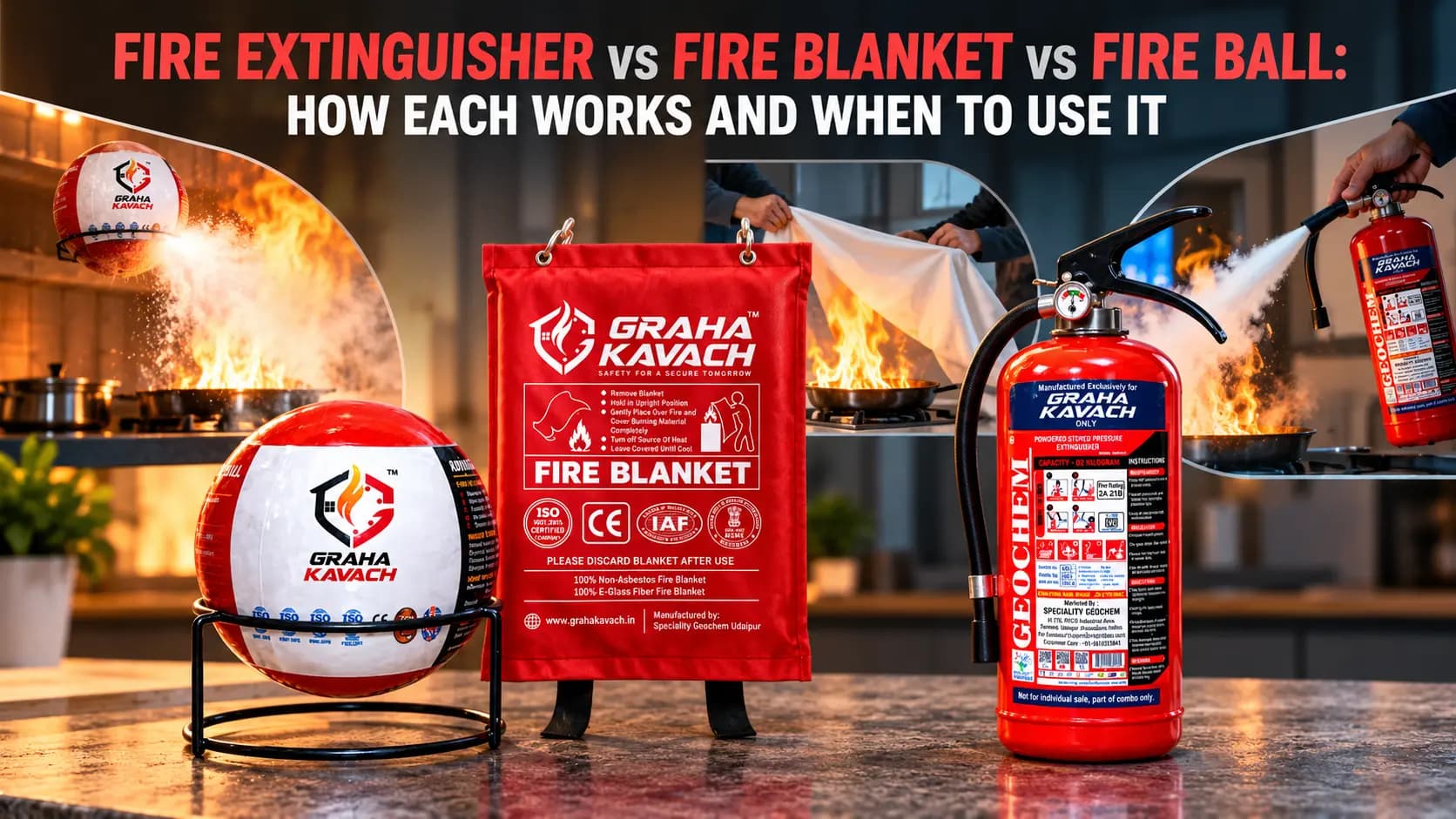
Fire Extinguisher vs Fire Blanket vs Fire Ball: How Each Works and When to Use It
A fire extinguisher, a fire blanket and a fire extinguisher ball can all put out a small fire, but they do it in very different ways and suit very different moments. Picking the wrong one in a panic can make things worse. This guide compares fire extinguisher vs fire blanket vs fire ball one pair […]