
Home Fire Safety Tips: 25 Practical Tips Every Family Should Follow
Graha Kavach Fire Safety Team

Most fires at home begin small: a pan left on the flame, a crowded socket, a diya too close to a curtain. Good home fire safety tips stop them at that stage. What happens next depends on habits built long before that moment. These 25 fire safety tips for Indian homes are grouped by where they apply, so you can read one block a day and put it into practice the same evening. None of them needs special skills, and most cost nothing at all.
| Block | Where it applies | Tips |
|---|---|---|
| A | Kitchen and cooking | 1 to 5 |
| B | LPG cylinder and gas line | 6 to 8 |
| C | Wiring, MCB panel and inverter | 9 to 12 |
| D | Pooja mandir, diyas and incense | 13 to 15 |
| E | Fire safety equipment | 16 to 20 |
| F | Your family’s escape plan | 21 to 25 |
Pin this table to the fridge and work through one block a week until all 25 fire safety tips are habits.
A. Kitchen and cooking: tips 1 to 5
The kitchen is where open flame, oil and gas meet every day, so these fire safety tips come first.
1. Stay with hot oil
A kadhai of oil can go from shimmering to burning in the time it takes to answer the door. If you need to step away, switch off the burner first.
2. Keep cloth away from the burners
Kitchen towels, dupattas, potholders and plastic packets catch fire fast. Hang them well clear of the cooktop, and tie back loose sleeves while you cook.
3. Clean grease off the stove and chimney
Built-up grease is fuel waiting for a spark. Wipe the cooktop after cooking and clean the chimney filter regularly.
4. Keep a lid and a fire blanket ready
A lid slid over a small pan fire cuts off its air. For anything bigger, use a fire blanket hung beside the kitchen door, a good 2 metres or more away from the cooktop. That way you grab it on the way out, not over the fire.
5. Never pour water on burning oil
Water makes burning oil splash and spread across the kitchen. Turn off the gas, then cover the pan. Our kitchen fire extinguisher guide explains what else belongs near the stove.
B. LPG cylinder and gas line: tips 6 to 8
Gas leaks give little warning, so the fire prevention tips in this block are about stopping gas before it reaches a flame.
6. Turn the regulator off at night and when you travel
The burner knob only stops gas at the stove. Switching off the regulator stops it at the cylinder, which is the habit that protects you while everyone sleeps or the house is empty.
7. Check the LPG pipe for cracks
Bend the rubber hose gently and look for cracks, hardening or loose ends. A damaged pipe should be replaced, not taped.
8. If you smell gas, do not create a spark
Turn off the regulator, open the windows and doors, and do not switch lights or appliances on or off until the smell has cleared. Leave the house and call for help if it does not.
C. Wiring, MCB panel and inverter: tips 9 to 12
Electrical fires often start behind furniture or inside a panel, out of sight. These fire safety tips deal with load, wiring and the hours when no one is watching.
9. Do not overload sockets
One socket running several heavy appliances through an extension board is a common risk, especially near the inverter or TV unit. Spread the load across sockets.
10. Never daisy-chain extension boards
Plugging one board into another multiplies the load on a single point. Replace worn cords instead of patching them.
11. Guard the spots nobody watches
The MCB panel and the inverter battery can heat up at night, during a power cut or when the family is away. A fire extinguisher ball mounted about 30 cm above each one activates on its own when flame reaches it.
12. Never use water on an electrical fire
Water conducts electricity. Cut the power at the MCB if you can do so safely, then use a dry powder extinguisher.
D. Pooja mandir, diyas and incense: tips 13 to 15
Daily prayer means a small open flame in most homes, and three fire prevention tips keep it safe.
13. Never leave a diya or incense burning alone
Put it out before you leave the room, go to bed or step out of the house.
14. Give the flame clear space
Keep diyas and incense sticks away from dry flowers, wooden shelves, curtains and fabric.
15. Use a stable, non-flammable base
A brass or steel plate under the diya catches falling ash and stops a tipped lamp from reaching the wood below.
E. Fire safety equipment: tips 16 to 20
The right equipment buys you the first few seconds, and these home fire safety tips make sure it works when needed.
16. Mount a 2 kg ABC fire extinguisher near an exit
Fix its wall bracket so the unit sits between 1 and 1.5 m off the ground, out of direct sunlight and away from moisture. Near an exit means you fight a fire with your way out behind you.
17. Learn the PASS method before you need it
Standing 3 to 4 metres back: pull out the pin, point the nozzle low where the flames start, press the lever down and move the nozzle side to side until the fire is out. Practise the motion once with the pin still in, using our PASS method guide.
18. Keep the fire blanket’s tapes hanging free
Mount it about 1.5 metres high near the kitchen exit, with both pull tapes loose so one tug releases it.
19. Do a 10-minute check once a month
Confirm the extinguisher gauge sits in the green zone and the pin and seal are intact, and check that the fire extinguisher ball and blanket are undamaged and in date.
20. Replace the fire blanket after any use
Once a blanket has covered flames or hot oil, it cannot be trusted again.
F. Your family’s escape plan: tips 21 to 25
Equipment helps only if everyone knows when to stop using it. These last fire safety tips are about getting out, and they matter most for children and elders.
21. Make sure everyone knows 101 and 112
Teach the numbers to children, elders and domestic help, save them in every phone at home, and go over these fire safety tips with the family every few months.
22. Keep exits clear and house keys in one known place
In smoke, nobody should have to search for keys or move boxes from the main door.
23. Fight only a small fire, and only with an exit behind you
Once flames grow past wastebasket size, smoke starts filling the room or the door looks like it could be cut off, stop and leave at once.
24. Crawl low and shut doors behind you
Smoke rises, so the cleaner air is about 30 to 60 cm above the floor. A closed door slows the fire and the smoke.
25. Never use a lift, and never go back inside
Use the stairs, meet at an agreed spot outside and count heads. Leave everything else to the fire service.
The six risk zones, mounting heights for each tool and the full monthly checklist are in our home fire safety guide.
Start with these three this week
If 25 feels like a lot, begin with the three home fire safety tips that protect you while you are not looking:
- Switch off the LPG regulator every night (tip 6).
- Take the extension boards off the inverter socket (tip 9).
- Teach everyone at home 101 and 112 (tip 21).
Add the rest one block at a time. Fire prevention tips only work once they become habits.
Conclusion
Our 3-in-1 fire safety kit packs the extinguisher (2 kg ABC), the fire extinguisher ball and the fibreglass fire blanket, plus the bracket, ball stand, screws and wall plugs to mount them. It costs ₹2,499, ships free anywhere in India, and you can pay cash when it arrives.
Frequently asked questions
Q1. What are the most important fire safety tips for home?
The fire prevention tips that matter most: never leave hot oil or a diya unattended, switch off the LPG regulator at night, avoid overloaded sockets, keep a 2 kg ABC extinguisher near an exit and make sure everyone knows 101 and 112.
Q2. What are simple fire safety tips for families with children?
Keep matches, lighters and diyas out of reach, teach children the numbers 101 and 112, and practise leaving the house by crawling low under smoke.
Q3. How often should home fire safety equipment be checked?
Once a month. Check that the extinguisher gauge is in the green zone, the pin and seal are intact, and the fire extinguisher ball and fire blanket are undamaged and in date.
Q4. Should I try to put out a fire myself?
Only if it is small, no bigger than a wastebasket, you have the right equipment and there is a clear exit behind you. Otherwise get everyone out, close the doors and call 101 or 112.
Q5. Can I use water on every fire at home?
No. Never use water on burning oil or grease, or on electrical fires. Use a fire blanket for pan fires and a dry powder extinguisher for electrical fires.
Verified Technical Direction
This guide was prepared in accordance with official Indian fire safety standards, chemical specifications from Speciality Geochem Udaipur, and the Graha Kavach Home Safety Manual. Always adhere to evacuation-first principles in an active fire.
Equip Your Home with Graha Kavach
Get the complete 3-in-1 kit: 2kg ABC Extinguisher, Automatic Fire Ball, and 550°C Fire Blanket for ₹2,499.
Related Safety Articles
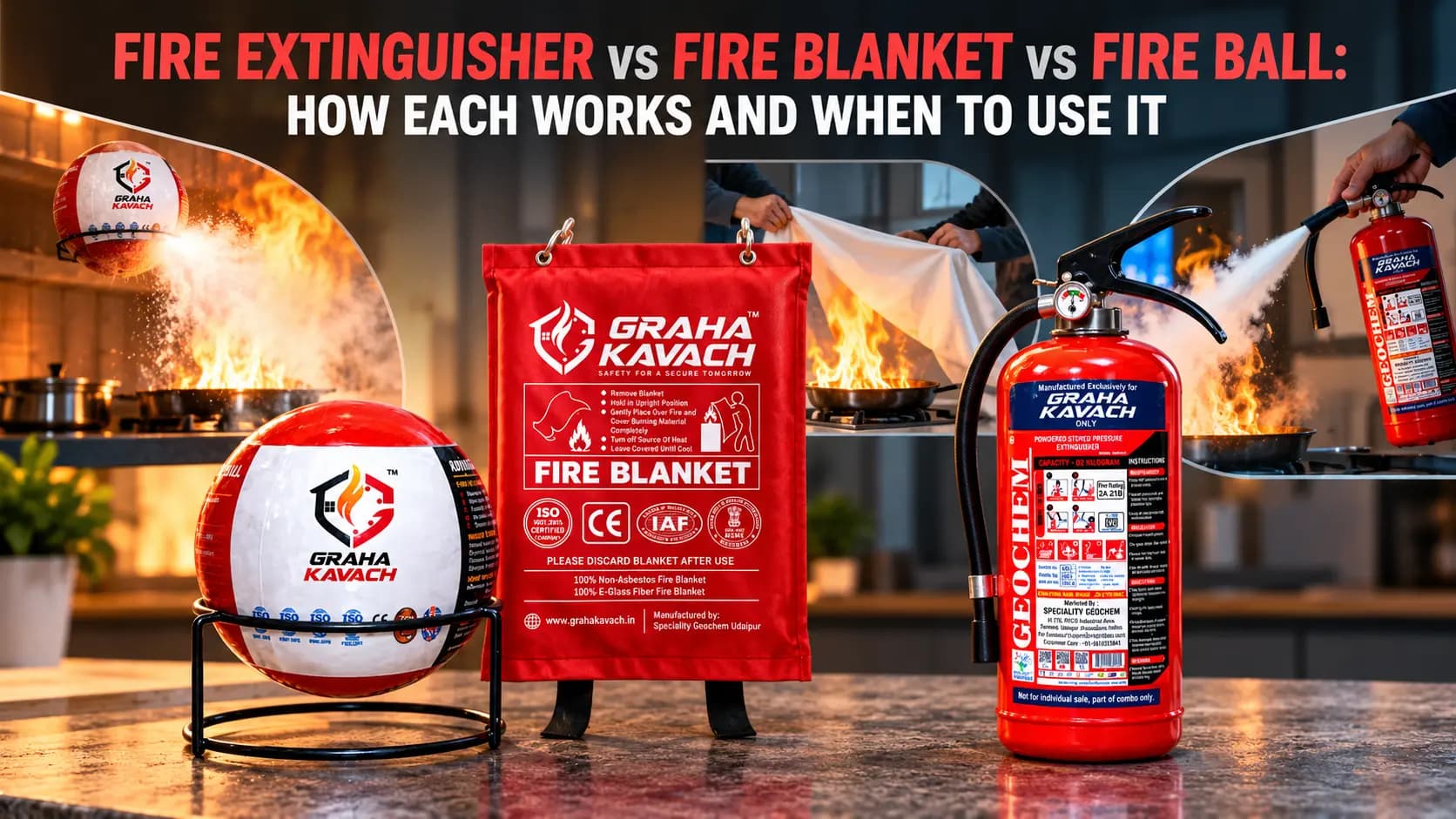
Fire Extinguisher vs Fire Blanket vs Fire Ball: How Each Works and When to Use It
A fire extinguisher, a fire blanket and a fire extinguisher ball can all put out a small fire, but they do it in very different ways and suit very different moments. Picking the wrong one in a panic can make things worse. This guide compares fire extinguisher vs fire blanket vs fire ball one pair […]
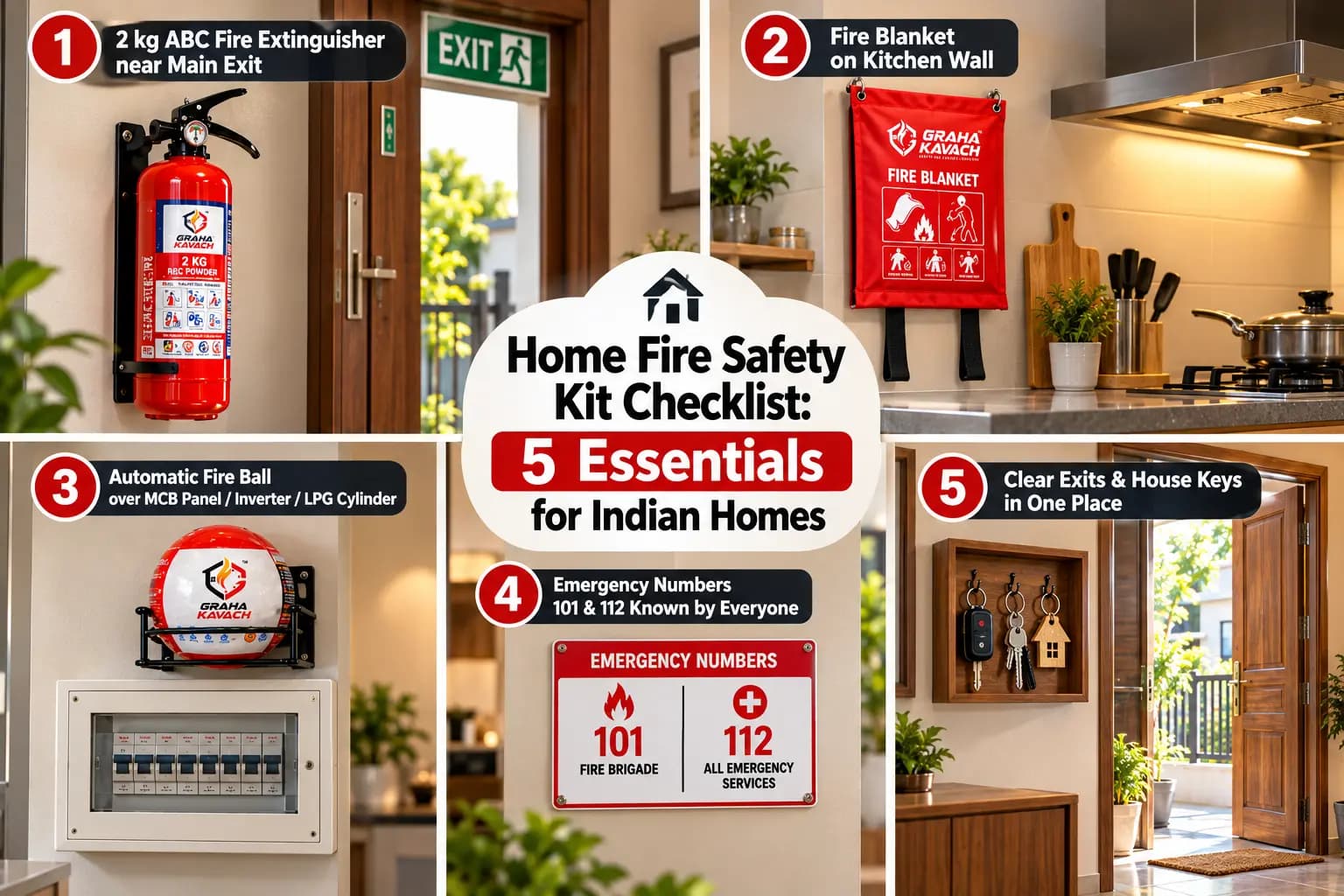
Home Fire Safety Kit Checklist: Essentials Every Indian Household Should Keep
Many Indian homes have no fire extinguisher at all, yet the common fire risks sit in almost every flat: an LPG cylinder, an MCB panel, an inverter battery and a pooja diya. A fire safety kit for home use does not need to be big, but it does need the right pieces in the right […]
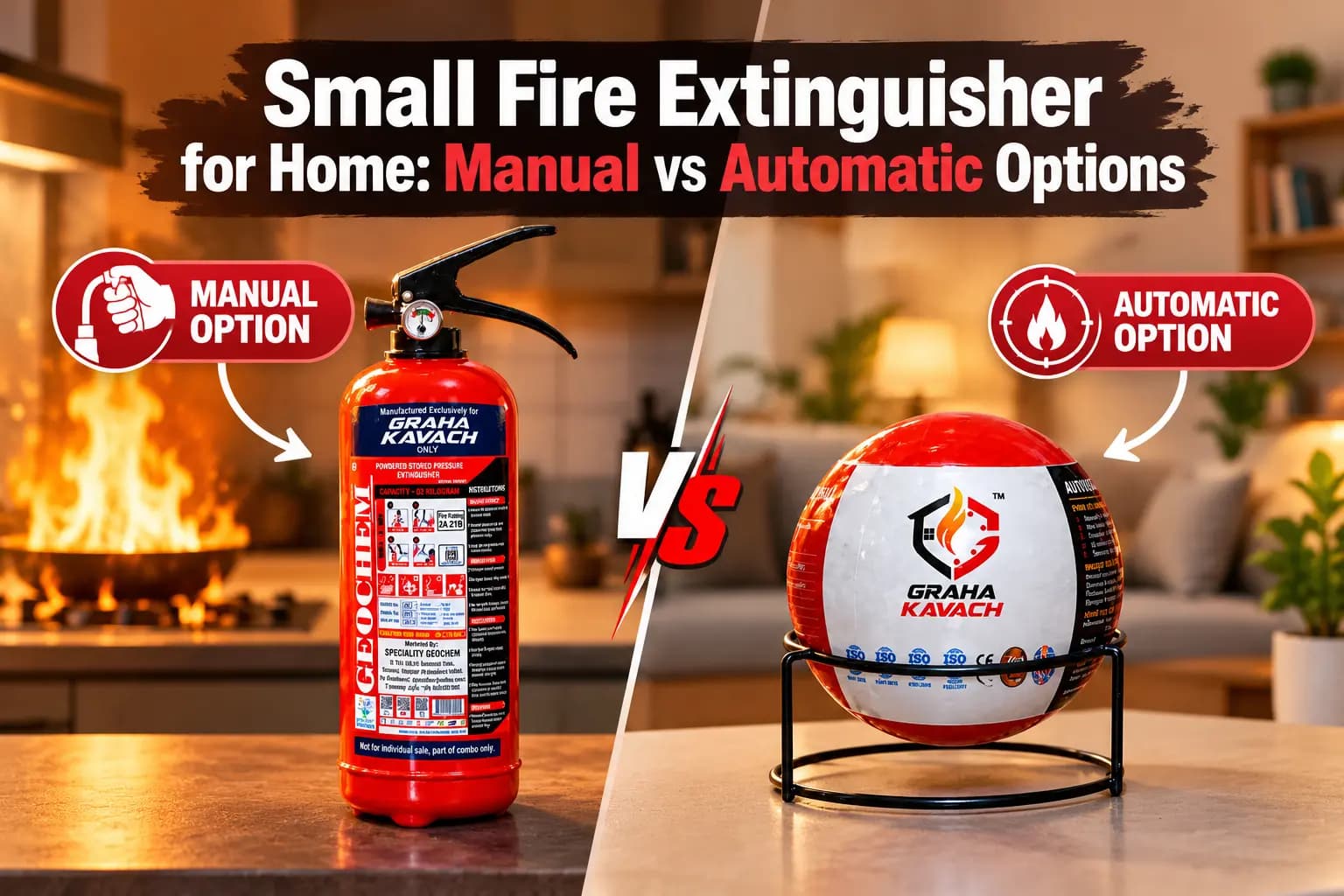
Small Fire Extinguisher for Home: Manual vs Automatic Options
A home does not need a large, heavy cylinder to be protected. A small fire extinguisher for home use is light enough to grab quickly, fits on a kitchen or hallway wall, and handles the small, early-stage fires that start at a plug point, an inverter or a pan of oil. The real choice is […]