
Common Causes of Home Fires in India and How to Prevent Them
Graha Kavach Fire Safety Team

A house fire rarely has a dramatic origin. It usually starts with something ordinary that everyone in the family has seen a hundred times: oil heating on the stove, a phone charger in a crowded socket, a lamp burning in the mandir. Knowing what starts a fire in your own house is the first step to stopping one. This guide to the causes of home fire risk walks through six high-risk areas found in most Indian homes, what actually goes wrong in each, the warning signs to look for and the fix for each one.
Why understanding the causes of home fires matters
Every fire needs three things: heat, fuel and air. Take one away and there is no fire. Each of the common causes of home fires below is simply a situation where heat meets fuel without anyone controlling it: a flame left alone, wiring that runs hotter than it should, or cloth and paper too close to a lamp. Once you can see where those three meet in your home, prevention becomes a short list of habits rather than guesswork.

Cause 1: Unattended cooking
What goes wrong-
Oil overheats while the cook steps away to answer the door or the phone, and catches fire. A dupatta, kitchen towel or plastic packet near the burner catches a flame. Grease built up on the stove or chimney filter ignites.
Warning signs-
Oil that smokes before food goes in, a chimney filter you cannot remember cleaning, cloth stored on the shelf just above the cooktop.
How to prevent it-
Stay in the kitchen while oil is on the flame, keep cloth and plastic well clear of the burners and clean grease regularly. Of all kitchen fire causes, walking away from hot oil is the easiest to avoid. If a pan does catch fire, never throw water on it: turn off the gas and cover it. Our kitchen fire extinguisher guide covers what to keep near the stove.
Cause 2: LPG leaks
What goes wrong-
Gas escapes from a cracked rubber pipe, a loose regulator or a burner knob left slightly open. It collects in the kitchen until something gives it a spark: a light switch, a match or the stove itself.
Warning signs-
A smell of gas, a hose that has gone hard or cracked, a regulator left on overnight.
How to prevent it-
Check the pipe regularly and replace it when it shows cracks. Switch the regulator off at night and whenever you travel. If you smell gas, do not touch any switch; open the windows, turn off the regulator and leave if the smell stays.
These two kitchen fire causes, cooking and gas, sit side by side, which is why the kitchen needs more attention than any other room.
Cause 3: Short circuits and overloaded wiring
What goes wrong-
A short circuit fire starts when current takes a path it should not, through damaged insulation or a loose connection, and the wire heats up fast. Overloading does the same thing more slowly: too many appliances on one socket push more current through the wire than it was built for.
Warning signs-
A short circuit fire often gives these warnings first:
- Plugs or switchboards that feel warm to the touch
- A burning plastic smell near a socket
- Sparks when you plug something in
- An MCB that trips again and again
- Extension boards plugged into other extension boards
How to prevent it-
Spread heavy appliances across separate sockets, replace frayed cords rather than taping them, and get a qualified electrician to look at any socket that sparks or any MCB that keeps tripping. A tripping MCB is a warning, not a nuisance to switch back on. Never use water on an electrical fire.
Cause 4: Inverter and battery backups
What goes wrong-
The inverter and its battery often sit in a corner under the stairs or behind furniture, where nobody looks. Loose terminals, poor ventilation or an overloaded socket nearby can make the area heat up, and because it runs during power cuts and at night, a short circuit fire here may start while the family is asleep.
Warning signs-
Heat around the battery, swollen or leaking battery casing, extension boards plugged in next to the inverter.
How to prevent it-
Keep the area ventilated and clear of boxes and cloth, keep extension boards away from it, and have the battery checked when you notice heat or swelling. Because this is a spot nobody watches, it suits a fire extinguisher ball on a stand just above the inverter. It needs no power, bursts when flame reaches it and sounds a loud alarm to wake the house.
Cause 5: Diyas, incense and candles
What goes wrong-
A diya placed near dry flowers, a curtain or a wooden shelf, an incense stick dropping hot ash, or a lamp left burning when the family goes out or to sleep.
Warning signs-
Burn marks on the mandir shelf, flowers and cloth piled around the lamp, a diya with no metal plate under it.
How to prevent it-
Never leave a diya or incense unattended, keep a clear space around the flame, and put out every lamp before you leave the room. During festivals, when a home may have dozens of lamps burning at once, this is one of the causes of home fires that needs extra care.
Cause 6: Air conditioners and heaters
What goes wrong-
Air conditioners draw heavy current, and a worn plug or an undersized extension board can overheat. Room heaters placed close to curtains, bedding or clothes can set them alight.
Warning signs-
A discoloured or warm AC plug, a heater running near fabric, a heater left on overnight.
How to prevent it-
Plug large appliances straight into a suitable wall socket, not an extension board, and keep heaters well away from anything that can burn.
Six causes of home fire at a glance

| Where | Common cause | Simple prevention | Automatic or first-response tool |
|---|---|---|---|
| Kitchen | Unattended oil, cloth near burners, grease | Stay with hot oil, keep cloth clear | Fire blanket near the kitchen exit |
| LPG cylinder | Leaking pipe or regulator | Check the pipe, regulator off at night | Fire extinguisher ball above the cylinder |
| MCB panel | Short circuit fire, overloading | Spread the load, call an electrician | Fire extinguisher ball above the panel |
| Inverter and battery | Heat, loose terminals, nearby overloads | Ventilation, no extension boards nearby | Fire extinguisher ball above the inverter |
| Pooja mandir | Diya or incense near flowers and cloth | Never leave a flame alone | 2 kg ABC extinguisher near the exit |
| AC and heaters | Overheated plugs, heaters near fabric | Wall sockets, clear space around heaters | 2 kg ABC extinguisher near the exit |
When prevention is not enough
Even a careful home can have a fire. Tackle it yourself only while it is still wastebasket-sized and your way out is open. If it has grown past that, the priority is people, not property: leave, pull the doors shut as you go and phone 101 or 112 from outside. The equipment placement and monthly check for each of these zones are in our fire safety checklist for home.
One kit for the riskiest spots-
Our 3-in-1 fire safety kit gives you a 2 kg ABC extinguisher for the corridor, a fire extinguisher ball for the MCB panel, inverter or LPG cylinder, and a 1 m x 1 m fibreglass fire blanket for the kitchen, plus the brackets and screws to fix them. Price ₹2,499; shipping is free to any Indian address and you can pay on delivery.
Frequently asked questions
Q1. What are the most common causes of home fires in India?
Unattended cooking, LPG leaks, short circuits and overloaded sockets, inverter and battery backups, diyas and incense near flammable items, and overheated air conditioner or heater plugs.
Q2. What causes a short circuit fire at home?
Damaged insulation, loose connections or too many appliances on one socket make wires overheat. Warm plugs, a burning plastic smell, sparks and an MCB that keeps tripping are early warning signs.
Q3. What are the main kitchen fire causes?
Oil left on the flame unattended, cloth or plastic near the burners, grease on the stove and chimney, and gas leaking from a damaged LPG pipe or a regulator left on.
Q4. Can an inverter battery cause a fire?
Yes, if it overheats from loose terminals, poor ventilation or overloaded sockets nearby. Keep the area clear and ventilated, and have the battery checked if it feels hot or looks swollen.
Q5. How can I prevent the common causes of home fires?
Deal with each cause at its source: stay with hot oil and lit diyas, turn the gas off at the cylinder before bed, give heavy appliances their own wall socket, and place an extinguisher, fire blanket and fire extinguisher ball where each risk sits.
Verified Technical Direction
This guide was prepared in accordance with official Indian fire safety standards, chemical specifications from Speciality Geochem Udaipur, and the Graha Kavach Home Safety Manual. Always adhere to evacuation-first principles in an active fire.
Equip Your Home with Graha Kavach
Get the complete 3-in-1 kit: 2kg ABC Extinguisher, Automatic Fire Ball, and 550°C Fire Blanket for ₹2,499.
Related Safety Articles
Home Fire Safety Tips: 25 Practical Tips Every Family Should Follow
Most fires at home begin small: a pan left on the flame, a crowded socket, a diya too close to a curtain. Good home fire safety tips stop them at that stage. What happens next depends on habits built long before that moment. These 25 fire safety tips for Indian homes are grouped by where […]

Fire Extinguisher vs Fire Blanket vs Fire Ball: How Each Works and When to Use It
A fire extinguisher, a fire blanket and a fire extinguisher ball can all put out a small fire, but they do it in very different ways and suit very different moments. Picking the wrong one in a panic can make things worse. This guide compares fire extinguisher vs fire blanket vs fire ball one pair […]
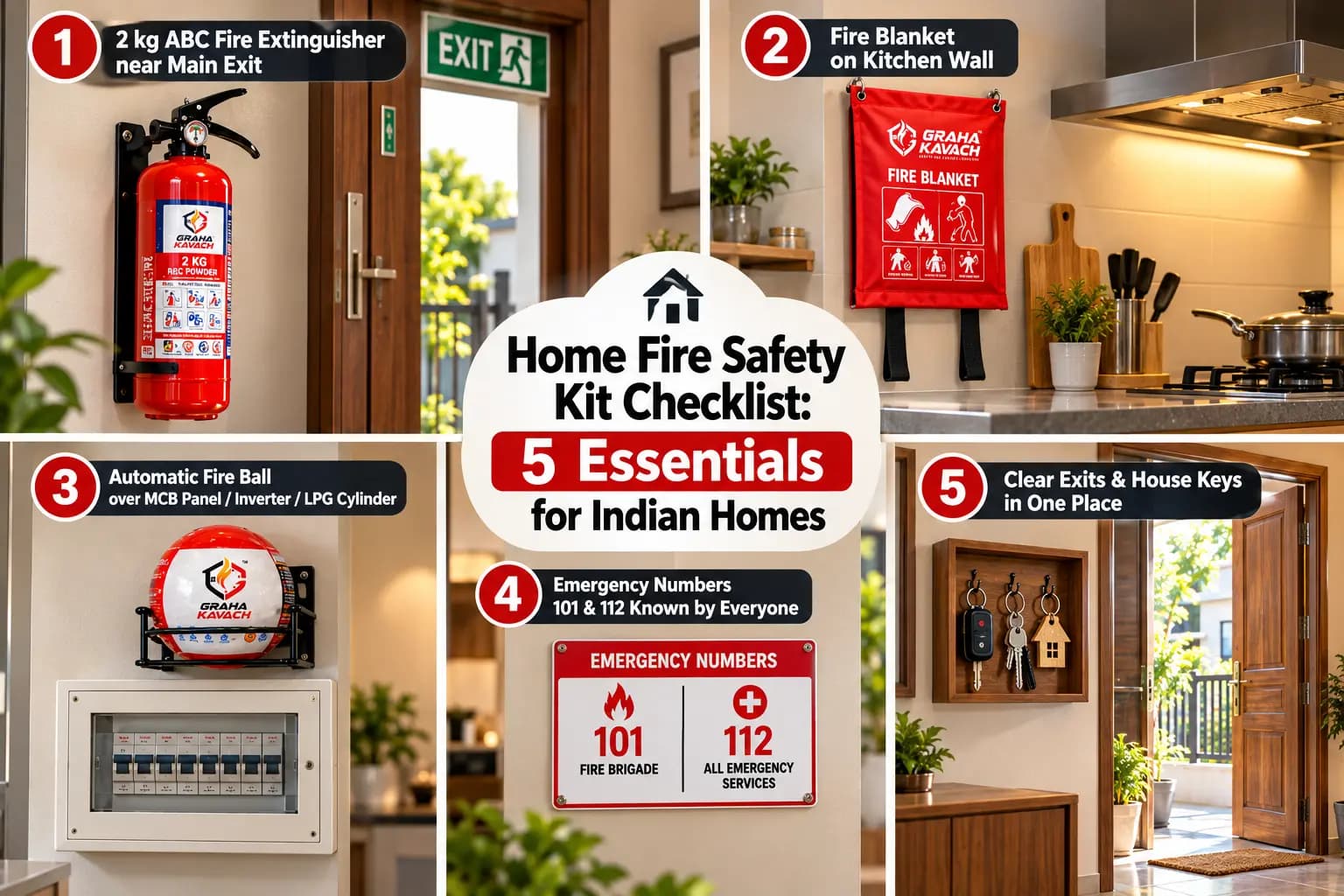
Home Fire Safety Kit Checklist: Essentials Every Indian Household Should Keep
Many Indian homes have no fire extinguisher at all, yet the common fire risks sit in almost every flat: an LPG cylinder, an MCB panel, an inverter battery and a pooja diya. A fire safety kit for home use does not need to be big, but it does need the right pieces in the right […]