
Electrical Fire at Home: Which Extinguisher to Use? CO2 vs ABC
Founder, Speciality Geochem
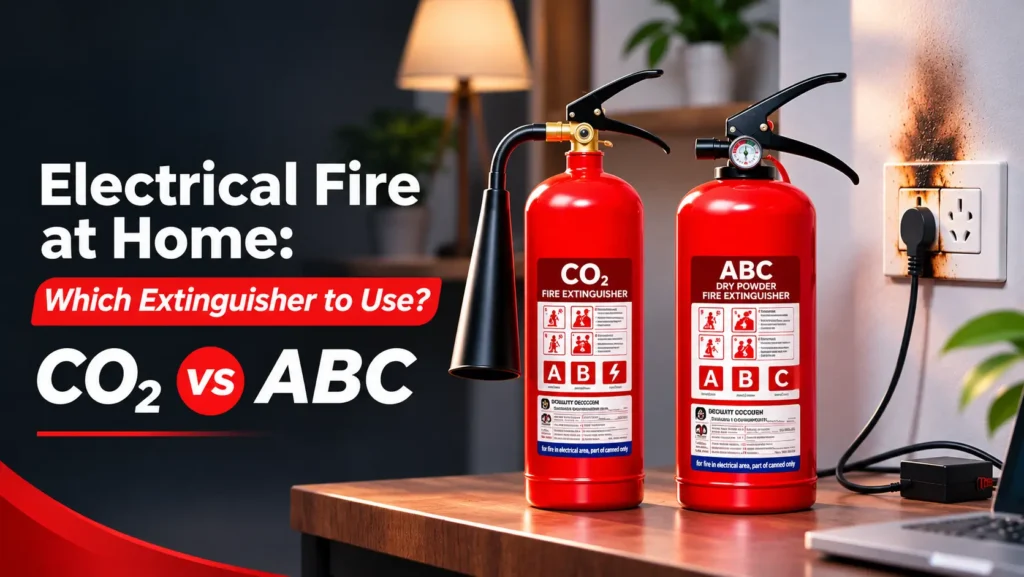
Quick answer: First, cut the power at the main switch or MCB if you can reach it safely. Then use a CO2 extinguisher on electronics and panels, because it leaves no residue. Use an ABC dry powder extinguisher when the fire has spread to curtains, wood or plastic around the appliance. Never use water on an electrical fire. For most homes, one ABC extinguisher plus a small CO2 near electronics covers both cases.
Electrical fires are tricky for one reason: the thing that’s burning can still give you a shock. The right extinguisher matters, but what you do in the ten seconds before you use it matters more.
First, a confusion worth clearing up
Many Indians read American websites that say “use a Class C extinguisher for electrical fires.” In India, that advice doesn’t translate directly.
- In the US system, Class C means electrical fires.
- In the Indian system (followed by BIS), Class C means flammable gases such as LPG. Electrical fires aren’t a separate class; instead, the extinguisher label tells you whether it’s safe to use on live electrical equipment.
So don’t shop for “Class C” when you mean electrical. Read the label for wording about electrical equipment, and the voltage limit if one is given.
Before you use any extinguisher on an electrical fire
- Cut the power. Switch off the MCB for that circuit or the main switch. If the fire is at the distribution board itself, don’t reach into it; use the main switch only if it’s away from the flames.
- Unplug only if it’s safe. Pull the plug from the wall socket, not by the wire, and only if the socket isn’t burning.
- Shout and alert everyone. Get children and elderly members out of the room.
- Decide in five seconds: is the fire small and contained, smaller than a dustbin? If not, leave, close the door and call 101 or 112.
Once power is off, the fire often becomes an ordinary fire of plastic, wire coating, wood or cloth. That changes which extinguisher works best.
CO2 vs ABC: how they compare at home
| Factor | CO2 extinguisher | ABC dry powder extinguisher |
|---|---|---|
| How it puts out fire | Displaces oxygen and cools the area | Coats the fuel and interrupts the fire’s chemical reaction |
| Residue | None; the gas disappears | Fine powder that spreads across the room |
| Effect on electronics | Safe for TVs, laptops, panels | Powder is corrosive and can damage electronics and motors |
| Wood, paper, cloth (Class A) | Not rated; can reignite once gas clears | Rated; works well |
| Small, closed rooms | Avoid in tight unventilated spaces; it displaces the air you breathe | Usable; ventilate afterwards |
| Clean-up | Nothing to clean | Vacuum and wipe; powder gets into gaps |
| Handling | The horn gets extremely cold; hold the handle, not the horn | No cold-burn risk |
The short version: CO2 protects the equipment; ABC handles the fire that spreads from it.
Which one to use, situation by situation
| What’s on fire | Use | Why |
|---|---|---|
| TV, laptop, desktop, set-top box | CO2 | No powder damage to nearby electronics |
| MCB panel or distribution board smoking | Main switch off, then CO2 | Clean agent for electrical panels |
| Extension board, and the curtain behind it has caught | Power off, then ABC | The curtain is now a Class A fire, which CO2 can’t fully handle |
| Inverter or UPS | Power off, then CO2; ABC if wiring and plastic around it are burning | Ventilate; batteries can release fumes |
| Split AC indoor unit | Switch off at MCB, then CO2 | Unit is mounted high; stay at a safe distance |
| Washing machine or fridge motor | Unplug, then CO2 or ABC | Either works once power is off |
| Charging e-scooter, EV or power bank | Don’t fight it; evacuate and call 101 or 112 | Lithium battery fires can reignite and release toxic gases |
Why never water
Water conducts electricity. Throwing water on a live electrical fire can give you a shock, and it can spread the fire through the wiring. Even after the power is off, water can damage the distribution board and create a hazard when power is restored. Leave water out of it entirely.
Which electrical fire extinguisher should you buy for home?
For most Indian homes, the practical setup is:
- One ABC dry powder extinguisher (2 kg to 4 kg) in the main living area or near the kitchen entrance. It covers most home fires, including electrical fires once the label confirms it’s suitable for electrical equipment.
- One small CO2 extinguisher (2 kg) near the home office, gaming setup, or the room with the main distribution board. This is optional but worth it if you have expensive electronics.
- A fire ball over the distribution board or inverter, for when no one is home.
If you buy only one, buy ABC. It’s more versatile, and in an emergency, saving lives matters more than saving the TV.
Prevention that matters more than the extinguisher
- Don’t run heaters, irons or geysers off extension boards; plug high-load appliances directly into a wall socket rated for them.
- Replace any socket that’s warm to touch, discoloured, or smells of burning plastic.
- Don’t cover chargers or adaptors with pillows or bedsheets while charging.
- Have an electrician check old wiring if your house is more than 15–20 years old or the MCB trips often.
Our guide on short-circuit warning signs (publishing 30 Dec) goes deeper into this.
Conclusion: find your main switch tonight
The most useful thing you can do for electrical fire safety takes two minutes and costs nothing. Find your main switch and the MCB for each room, label them clearly with a marker, and show everyone at home where they are. In a real electrical fire, the person who can cut the power in five seconds is the one who keeps a small fire small. The extinguisher comes second. Pair an ABC extinguisher with a fire ball over your MCB panel. See the 3-in-1 fire safety kit.
Frequently Asked Questions
Q1. Can I use an ABC extinguisher on an electrical fire?
Yes, if the label says it’s suitable for electrical equipment. It works, but expect powder damage to nearby electronics.
Q2. Is a CO2 fire extinguisher safe for home use?
Yes, used correctly. Don’t use it in a small closed room with people inside, and never hold the discharge horn.
Q3. Does a CO2 extinguisher need refilling?
Yes, after any use, even partial. CO2 units don’t have a pressure gauge, so they are checked by weight during servicing.
Q4. What if the fire is inside the wall?
Switch off the main supply, get out and call the fire brigade. A hidden fire can’t be reached with a portable extinguisher.
Verified Technical Direction
This guide was prepared in accordance with official Indian fire safety standards, chemical specifications from Speciality Geochem Udaipur, and the Graha Kavach Home Safety Manual. Always adhere to evacuation-first principles in an active fire.
Equip Your Home with Graha Kavach
Get the complete 3-in-1 kit: 2kg ABC Extinguisher, Automatic Fire Ball, and 550°C Fire Blanket for ₹2,499.
Related Safety Articles
Lithium Battery Fires at Home: Phones, Laptops, E-Bikes & EV Charging
Quick answer: To prevent a lithium battery fire at home, charge devices with their original charger, on a hard surface, and never overnight under a pillow or in a closed room. Charge e-scooters outside the flat, away from the exit. Stop using any battery that swells, gets very hot or smells sweet. If one catches […]

What Is a Fireproof Blanket? Material, Size & Fire Rating Explained
Quick answer: A fireproof blanket is a sheet of woven fire-resistant fabric, usually fibreglass, that puts out a small fire by cutting off its oxygen. Home blankets are commonly 1 m × 1 m. No blanket is truly “fireproof”; a good one resists flame and heat long enough to smother a pan or clothing fire […]
Recommended Fire Extinguisher for Home: Answer 4 Questions
“Which fire extinguisher should I buy?” is the question families ask us most often. Usually they have spent an evening comparing ABC, CO2 and foam listings, then closed the tab more confused than before. So try this instead. Don’t study every type. Answer four questions about your own home, and your answers will point to […]