
What Is a Fireproof Blanket? Material, Size & Fire Rating Explained
Founder, Speciality Geochem
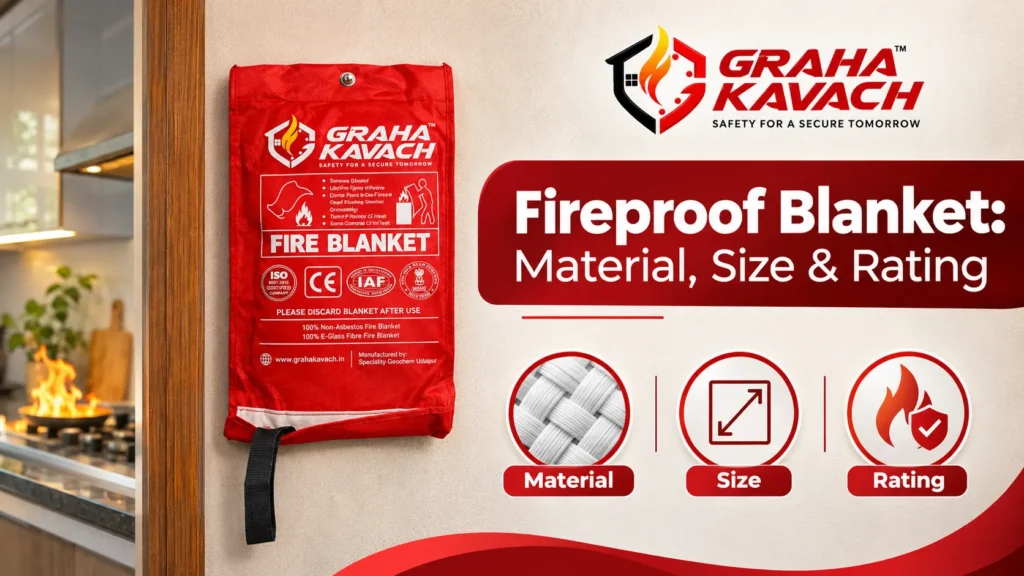
Quick answer: A fireproof blanket is a sheet of woven fire-resistant fabric, usually fibreglass, that puts out a small fire by cutting off its oxygen. Home blankets are commonly 1 m × 1 m. No blanket is truly “fireproof”; a good one resists flame and heat long enough to smother a pan or clothing fire safely.
Key takeaways
- A fireproof blanket smothers fire by blocking oxygen.
- Woven fibreglass is the most common material because it does not burn.
- 1 m × 1 m suits a home kitchen; 1.8 m × 1.8 m is for wrapping a person or industrial use.
- IS 15381:2003 is India’s fire blanket standard; BS EN 1869 is the European one.
- For anything bigger than a small, contained fire, leave and call 101 or 112.
What is a fireproof blanket, and how does it put out a fire?
It is a folded sheet of fire-resistant cloth kept in a quick-release pouch. Pull the tapes and it drops open, ready to place over the fire.
Fire needs heat, fuel and oxygen. The blanket removes oxygen, so once it seals a burning pan or wraps burning clothes, the flame starves within seconds. Unlike an extinguisher, it leaves no powder to clean up. You may also see it sold as an “emergency fire blanket” or “fire safety blanket”.
What is a fireproof blanket made of?
Most home blankets use woven fibreglass, often coated so the cloth stays soft and does not shed fibres.
| Material | Approx. heat tolerance of the fibre | Where it is used |
|---|---|---|
| Fibreglass (woven glass fibre) | Up to about 1,200 °C | Homes, kitchens, offices |
| Aramid (Kevlar-type) | About 480 °C | Protective wear, labs |
| Treated wool | About 570 °C | Older or traditional blankets |
| Silica / ceramic fabric | Higher than fibreglass | Welding and industrial use |
General material values, not ratings for any one product. Check the label on the blanket you buy.
Fibreglass suits homes because it is light, folds small and easily handles a cooking-oil fire, which usually starts somewhere above 300 °C.
Is a fireproof blanket really fireproof?
Not literally. “Fireproof blanket” is the everyday term, but the accurate word is fire-resistant. The fabric does not burn, yet the side touching the flame gets very hot and edges can char after long contact. Treat it as a tool for the first seconds of a small fire, not a shield to stand behind.
What size of fireproof blanket do you need at home?
Too small, and flames escape round the edges; too large, and it is hard to handle in a tight Indian kitchen.
| Size | Best for |
|---|---|
| 1 m × 1 m | Kadhai, pan or tawa fires, small bin fires, a burning dupatta |
| 1.2 m × 1.2 m | Larger cookware, small appliance fires |
| 1.8 m × 1.8 m | Wrapping an adult whose clothes are on fire, labs, factories |
For most flats, a 1 m × 1 m fireproof blanket is the practical choice. The fire blanket in the Graha Kavach 3-in-1 fire safety kit is exactly this size: 1 m × 1 m fibreglass, packed in a quick-release pouch.
What do fire ratings and standards on a blanket mean?
- IS 15381:2003 (India): The Bureau of Indian Standards specification for fire blankets, covering material, manufacture and the 1.8 m × 1.8 m size. You can read the BIS preview of IS 15381. (outbound link, opens in a new tab)
- BS EN 1869 (Europe): Tests whether a blanket can put out a small cooking-oil fire and how fast it pulls from its pouch.
A rating means the blanket was tested to a set method. If a seller only says “100% fireproof” with no standard, maker’s address or manufacturing date on the pouch, ask for the test report.
How do you use a fireproof blanket, in brief?
- Pull both tapes sharply.
- Hold it in front of you, hands tucked behind the top edge.
- Lay it over the fire, away from your body. Do not throw it.
- Switch off the gas or power, and leave the blanket in place for at least 30 minutes until the pan cools.
See how the Graha Kavach kit works for the blanket, extinguisher and fire ball together.
Where should you keep a fireproof blanket in an Indian home?
Mount it on the kitchen wall, 1.5 to 2 metres from the stove and near the exit, so you never lean over the flame to reach it. Don’t keep it inside a closed cabinet or behind the LPG cylinder. Our guide on the fire blanket for kitchen use covers oil and pan fires. For unwatched risk points like an MCB board or inverter, an automatic fire extinguisher ball is the better fit.
When should you NOT use a fireproof blanket?
A blanket is not enough when:
- The fire is larger than the blanket or has reached curtains, cabinets or the ceiling.
- The room is filling with smoke.
- An LPG cylinder or pipe is involved and you cannot shut the regulator safely.
- It is a live electrical fire you cannot switch off at the MCB.
Get everyone out, close the door and call 101 (fire) or 112 (emergency). For small fires on wood, cloth, paper, liquids or LPG, a 2 kg ABC fire extinguisher for home is the next layer.
Three layers of protection: The Graha Kavach 3-in-1 kit combines a 2 kg ABC extinguisher, an automatic fire ball and a 1 m × 1 m fibreglass fire blanket, with free delivery across India. Graha Kavach is the home fire-safety brand of Speciality Geochem, Udaipur (since 2010).
Frequently Asked Questions
Q1. What is a fireproof blanket made of?
Most home fireproof blankets use woven fibreglass, which does not burn and tolerates far more heat than a kitchen fire produces. Industrial ones may use silica or aramid.
Q2. Is a fire blanket better than a fire extinguisher?
Neither replaces the other. A blanket suits pan fires and burning clothes with no mess; an extinguisher reaches further and handles larger fires. Keep both.
Q3. Can a fireproof blanket be reused?
Treat it as single-use. Heat weakens the weave and oil soaks in, so replace it after a real fire even if it looks fine.
Q4. Does a fire blanket expire?
The fabric ages slowly, but the pouch and tapes can wear. The Graha Kavach kit lists a 5-year shelf life; check the pouch for damage now and then.
Q5. Can I use a fire blanket on a person whose clothes are on fire?
Yes. Get them to stop, drop and roll, then wrap the blanket from the neck down. Cool burns under clean running water and get medical help.
Q6. Is a fireproof blanket safe for an electrical fire?
Only after switching off power at the MCB. If you cannot cut the power, use a CO2 or ABC extinguisher, or leave and call 101.
Q7. Can I wash or refold a fire blanket?
Do not wash it. If you opened it only to inspect, refold it along the original creases with the tapes hanging down, ready to pull.
Q8. Which certification should I look for on a fireproof blanket in India?
Look for IS 15381 or BS EN 1869 on the pouch, plus the manufacturer’s name, address and manufacturing date.
Verified Technical Direction
This guide was prepared in accordance with official Indian fire safety standards, chemical specifications from Speciality Geochem Udaipur, and the Graha Kavach Home Safety Manual. Always adhere to evacuation-first principles in an active fire.
Equip Your Home with Graha Kavach
Get the complete 3-in-1 kit: 2kg ABC Extinguisher, Automatic Fire Ball, and 550°C Fire Blanket for ₹2,499.
Related Safety Articles
Lithium Battery Fires at Home: Phones, Laptops, E-Bikes & EV Charging
Quick answer: To prevent a lithium battery fire at home, charge devices with their original charger, on a hard surface, and never overnight under a pillow or in a closed room. Charge e-scooters outside the flat, away from the exit. Stop using any battery that swells, gets very hot or smells sweet. If one catches […]
Recommended Fire Extinguisher for Home: Answer 4 Questions
“Which fire extinguisher should I buy?” is the question families ask us most often. Usually they have spent an evening comparing ABC, CO2 and foam listings, then closed the tab more confused than before. So try this instead. Don’t study every type. Answer four questions about your own home, and your answers will point to […]

Fire Extinguisher Cylinder Explained: Capacity, Weight & Right Size for a Home
Quick answer: A fire extinguisher cylinder is a pressurised steel container that holds an extinguishing agent, such as ABC dry powder. It pushes the agent out through a valve and nozzle when you squeeze the lever. Its “capacity” (1 kg, 2 kg, 4 kg and so on) is the weight of agent inside, not the […]