
LPG Cylinder Fire Safety at Home: Prevention & What to Do in an Emergency
Founder, Speciality Geochem
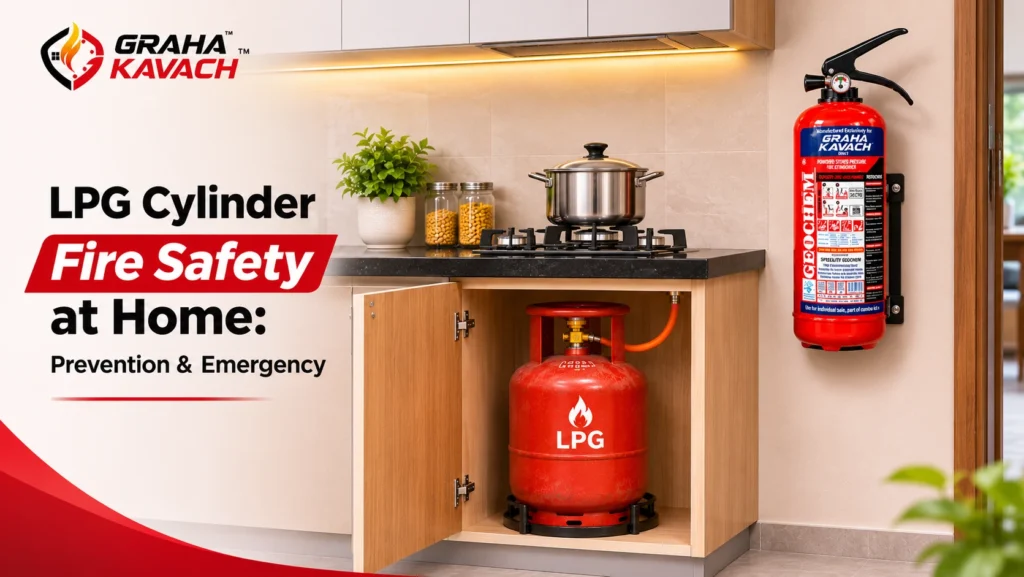
Quick answer: If an LPG cylinder catches fire at the regulator or hose, protect your hand with a wet cloth and turn the regulator knob to OFF. A small flame usually dies once the gas stops. If you cannot reach the knob, or the fire is spreading, get everyone out and call 101 or 112. For a gas leak, call the LPG emergency helpline 1906.
Key takeaways
- LPG has no smell of its own. The strong odour is added so that you notice a leak.
- LPG is heavier than air, so leaked gas settles near the floor and in corners.
- Most kitchen LPG fires start at a cracked hose, a loose regulator or a worn rubber washer.
- The code on the cylinder collar, such as “B-27”, shows when the cylinder is due for testing.
- 1906 is the common LPG emergency helpline for Indane, Bharatgas and HP Gas customers.
Why do LPG fires happen at home?
An LPG cylinder is built to strict standards and rarely fails on its own. The trouble usually starts at the weak points around it. A rubber hose dries and cracks after a few summers. A regulator is not pushed fully onto the valve. The rubber “O” ring inside the valve gets damaged, and gas seeps out each time the regulator is fitted.
In many Indian kitchens, the cylinder sits right under the stove, next to a dustbin, old newspapers and a cleaning cloth. A leak plus one spark from a light switch, a matchstick or a mixer motor is enough to start a fire.
How do you know if there is an LPG leak?
- A strong smell of rotten eggs or cabbage, especially near the floor.
- A faint hissing sound from the hose or regulator.
- Gas finishing much faster than usual.
- Soap water bubbling when brushed on the hose joints. Never use a flame to check for a leak.
What should you do in an LPG emergency?
| Situation | Do this | Never do this |
|---|---|---|
| Gas smell, no fire | Turn regulator OFF, open doors and windows, put the safety cap on, call 1906 from outside | Switch lights, fans or the exhaust on or off, or light a match |
| Small flame at regulator or hose | Cover your hand with a wet cloth and turn the regulator OFF | Pour water on the flame, or pull the hose off |
| Fire spreading to the kitchen | Get everyone out, close the kitchen door, call 101 or 112 | Go back in to save the cylinder or belongings |
| Cylinder surrounded by fire | Leave the building and keep people far away | Try to move or cool the cylinder yourself |
The main rule is simple: stop the gas before you put out the flame. If you put out a gas flame while gas is still flowing, the gas keeps leaking and can explode when it reaches another spark.
The government’s LPG safety pledge puts it the same way: switch off the regulator, avoid touching electrical or battery-operated equipment, and call 1906.
What if the fire spreads beyond the cylinder?
Once the gas is off, what is left is an ordinary kitchen fire: a burning cloth, a cabinet door or a curtain. A 2 kg ABC extinguisher is rated for Class C gas fires as well as Class A solids, which is why it suits the kitchen. Aim at the base of the burning material from 1–2 metres away.
If oil in a kadhai has caught fire too, do not throw water on it. Follow the steps in our guide on what to do in a cooking oil fire. To decide where to mount your unit, read what to keep near your stove.
When not to fight the fire: if flames are around the cylinder body, the kitchen is filling with smoke, or you cannot reach the regulator safely, leave at once, close the door and call 101 or 112 from outside.
How do you prevent LPG fires every day?
- Keep the cylinder upright and below the level of the stove, on the floor, never in a closed cabinet without ventilation.
- Use only an ISI-marked Suraksha hose from your distributor, and replace it before the expiry date printed on it.
- Turn off the regulator at night and when you leave home, not just the stove knobs.
- Check the test-due code on the cylinder collar at delivery. “A”, “B”, “C” and “D” stand for the quarters of the year, and the number is the year. Refuse a cylinder that is past due.
- Check the seal and safety cap on a new cylinder before you accept it.
- Get servicing only from your distributor’s mechanic, never a local repairman.
- Keep the area around the cylinder clear of paper, cloth, plastic and spare cylinders.
At Graha Kavach, by Speciality Geochem, Udaipur (since 2010), we recommend one more habit: keep an extinguisher near the kitchen exit, not behind the stove. If you have to reach past the fire to get it, it is in the wrong place. For a full room-by-room check, see our home fire safety guide.
Which fire safety items should a kitchen have?
A kitchen with LPG needs three things within reach of the door: a small ABC fire extinguisher for home, a fire blanket for pan and clothing fires, and a working smoke alarm outside the kitchen. An automatic fire ball near the stove adds cover when no one is in the kitchen.
Get all three in one box: The Graha Kavach 3-in-1 Fire Safety Kit has a 2 kg ABC extinguisher with a gauge, an automatic fire ball with stand, and a 1 m × 1 m fibreglass fire blanket, delivered free across India.
Frequently Asked Questions
Q1. What should I do if my LPG cylinder catches fire?
If the flame is small and at the regulator or hose, cover your hand with a wet cloth and turn the regulator OFF. If you cannot reach it or the fire is spreading, get out, close the door and call 101 or 112.
Q2. Can an LPG cylinder explode?
A cylinder rarely explodes on its own. It can burst if it is surrounded by fire and heated for a long time. That is why you should leave the building if flames reach the cylinder body.
Q3. What is the LPG emergency number in India?
Dial 1906 for an LPG leak. It works for Indane, Bharatgas and HP Gas customers. For a fire, call 101 or 112.
Q4. Should I switch on the exhaust fan during a gas leak?
No. Do not switch any electrical appliance on or off, because the switch can spark. Open doors and windows to let the gas out naturally.
Q5. Can I use water on an LPG fire?
Water does not stop the gas, so it will not put out the source. First stop the gas at the regulator. Water can help cool nearby burning material only after the gas is off.
Q6. Which fire extinguisher is best for an LPG fire at home?
A 2 kg ABC dry powder extinguisher works on gas (Class C) and on solids like cloth and wood (Class A). Use it on what is burning after the gas has been shut off.
Q7. How often should I replace my LPG hose?
Replace it before the expiry date printed on the hose, or sooner if it looks cracked, hard or swollen. Buy only the ISI-marked Suraksha hose from your distributor.
Q8. How do I read the test date on an LPG cylinder?
Look for a code like “B-27” on the metal strips under the collar. The letter is the quarter (A for Jan–Mar to D for Oct–Dec) and the number is the year the test is due.
Q9. Is it safe to keep the LPG cylinder inside a cabinet?
Only if the cabinet has proper ventilation at the bottom, because leaked gas settles low. A closed cabinet lets gas build up. An open stand on the floor below the stove is safer.
Verified Technical Direction
This guide was prepared in accordance with official Indian fire safety standards, chemical specifications from Speciality Geochem Udaipur, and the Graha Kavach Home Safety Manual. Always adhere to evacuation-first principles in an active fire.
Equip Your Home with Graha Kavach
Get the complete 3-in-1 kit: 2kg ABC Extinguisher, Automatic Fire Ball, and 550°C Fire Blanket for ₹2,499.
Related Safety Articles
Fire Safety in High-Rise Buildings: What Residents Should Know in India
Quick answer: In a high-rise fire, use the stairs and never the lift. If the fire is in your flat, get everyone out, close the door behind you and raise the alarm. If the corridor is full of smoke, stay inside, seal the door gaps with wet towels and call 101 or 112. Know your […]
Lithium Battery Fires at Home: Phones, Laptops, E-Bikes & EV Charging
Quick answer: To prevent a lithium battery fire at home, charge devices with their original charger, on a hard surface, and never overnight under a pillow or in a closed room. Charge e-scooters outside the flat, away from the exit. Stop using any battery that swells, gets very hot or smells sweet. If one catches […]

What Is a Fireproof Blanket? Material, Size & Fire Rating Explained
Quick answer: A fireproof blanket is a sheet of woven fire-resistant fabric, usually fibreglass, that puts out a small fire by cutting off its oxygen. Home blankets are commonly 1 m × 1 m. No blanket is truly “fireproof”; a good one resists flame and heat long enough to smother a pan or clothing fire […]