
Car vs Home Fire Extinguisher: Why One Cylinder Can’t Do Both Jobs
Founder, Speciality Geochem
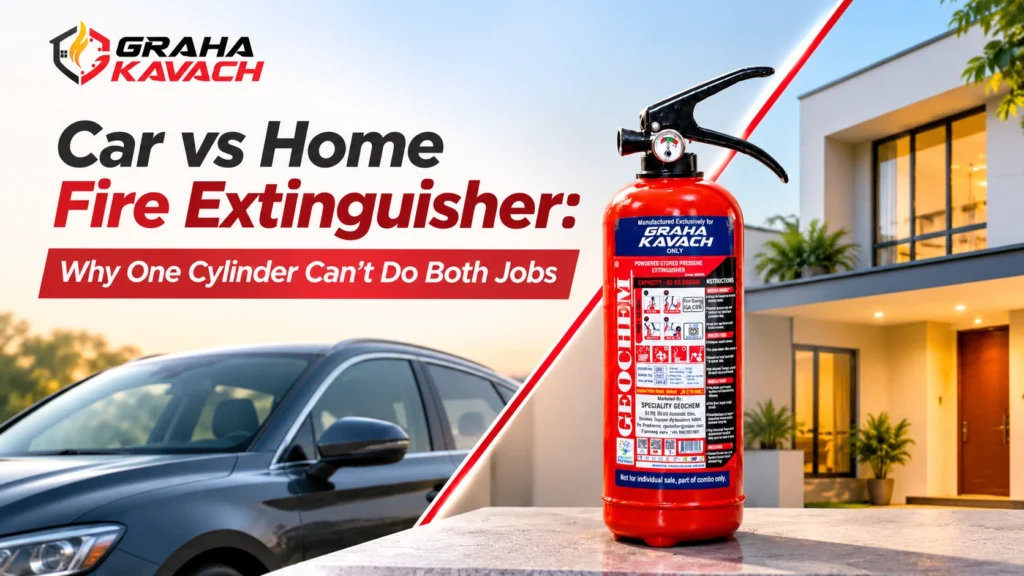
Quick answer: Use the same type of extinguisher, ABC dry powder, for both your home and your car, but not the same setup. At home, keep a 2 kg ABC extinguisher plus a fire blanket for the kitchen and an automatic fire ball for when nobody is around. In the car, mount a separate 1 kg ABC extinguisher on a bracket within the driver’s reach. One cylinder carried between the two is never where you need it when a fire starts.
Why people ask this question
Most families buy a fire extinguisher once and then wonder where it should live. Should it be in the kitchen, the car boot, or moved between them depending on the day? It is a fair question. ABC dry powder works on the fires that start in both places: cloth and plastic (Class A), petrol, diesel and cooking fuel (Class B), and LPG or CNG (Class C). Where the two places differ is who is nearby, how quickly the fire grows, and how much time you have.
Homes are where most fire accidents in India happen. NCRB data for 2024 shows residential buildings were the most common location for fire accidents, with cooking gas and electrical short circuits causing a large share. So start with the home.
What the home side needs: a 2 kg ABC dry powder unit
If you are asking which fire extinguisher you should buy for your home, the answer for most Indian flats and houses is a 2 kg ABC dry powder extinguisher. Here is why:
- It covers the fires that actually start at home. Curtains, mattresses and wooden furniture (A), kerosene, paint or thinner (B), and a leaking LPG pipe (C). For electrical fires, switch off the power first.
- Anyone at home can lift it. A 2 kg cylinder is light enough for a parent, a teenager or someone living alone to lift and aim with one hand. Bigger 4–6 kg units are made for shops and godowns.
- It gives you about 10–12 seconds of discharge. That is enough for a small, early fire, which is the only kind anyone should fight.
Before you pay, check for the ISI mark, IS 15683 and a CM/L licence number on the label. Our guide to which fire extinguisher you should buy for home walks through the choice in four questions.
Why a 3-in-1 kit helps most when you are alone at home
One extinguisher assumes one thing: that someone is standing near it, awake, when the fire starts. Real homes don’t work like that. You may be alone with a child in the next room. You may be asleep, or out at work while the inverter or a phone charger is still on.
That is why a 3-in-1 fire safety kit gives a home three different layers:
| Situation at home | What helps | Why |
|---|---|---|
| You see a small fire and can reach it | 2 kg ABC extinguisher | A manual first response, aimed at the base of the flame |
| Oil in a kadai catches fire while you cook alone | 1 m × 1 m fire blanket | You cover the pan in seconds; never use water on oil |
| A fire starts near the MCB panel or store room while nobody is there | Automatic fire ball | It activates when flame touches it, with no person needed |
The Graha Kavach kit puts all three in one box, with mounting hardware, for ₹2,499. It is made by Speciality Geochem, whose quality, environmental and occupational health and safety management systems are certified to ISO 9001:2015, ISO 14001:2015 and ISO 45001. If you are choosing a fire extinguisher for home, this is the setup we recommend.
The best fire extinguisher for a car: 1 kg ABC on a bracket
Car fires usually begin with a mechanical or electrical fault: a fuel leak, a loose battery terminal, or an aftermarket wiring job. For a private car, choose a 1 kg ABC dry powder extinguisher. It handles fuel, upholstery and wiring fires, and is small enough to use in a tight space.
- Fix it with a bracket. Mount it under the front passenger seat or in the front footwell. A loose cylinder rolling in the boot is hard to reach and can hurt someone in a sudden stop.
- Keep it within the driver’s reach. If you have to unload luggage to reach it, it’s in the wrong place.
- Check it more often than the one at home. Vibration and heat are harder on a car unit, so look at the gauge every month.
Is it safe in a hot car?
Yes, with care. A closed car parked in strong sun gets much hotter than the air outside. Extinguisher makers publish a storage temperature range on the label; Kidde, for example, says vehicle units are fine between −40 and 120 °F (about 49 °C). Read the range on your own cylinder, park in shade when you can, keep the unit out of direct sun, and replace it if the gauge drops out of the green.
Is it compulsory in a private car?
State motor vehicle rules require public service vehicles to carry a fire extinguisher. We could not find a central rule making one compulsory in a private car, but it costs little and can stop a small fire from becoming a total loss.
If your car catches fire: pull over, switch off the engine, get everyone out and well away, then call 112. Only use the extinguisher on a small fire you can reach from a safe distance. Don’t fully open a bonnet with smoke or flames under it, because fresh air feeds the fire. For electric cars and scooters, don’t fight a battery fire at all; see our guide to lithium battery fires.
Home vs car at a glance
| Home | Car | |
|---|---|---|
| Extinguisher type | ABC dry powder | ABC dry powder |
| Size | 2 kg | 1 kg |
| Where | Wall-mounted near the kitchen exit or main door | Bracket under the front seat or in the footwell |
| Extra protection | Fire blanket for the kitchen; automatic fire ball for when nobody is home | Usually none needed |
| Check | Gauge every month | Gauge every month, plus after long trips in summer |
So, one extinguisher or two?
Two. Use the same ABC type, but a separate unit for each place. The home needs more because more can go wrong there, and often nobody is watching: a kitchen, a dozen chargers, an inverter, and family members who may be alone. That is the job of the Graha Kavach 3-in-1 kit. Keep it at home, and give the car its own 1 kg unit.
Frequently Asked Questions
Q1. Can I use the same fire extinguisher at home and in my car?
The same ABC dry powder type works in both, but keep a separate unit in each place. An extinguisher moved between home and car is rarely where you need it when a fire starts.
Q2. Which fire extinguisher is best for a car in India?
A 1 kg ABC dry powder extinguisher with the ISI mark, fixed with a bracket under the front seat or in the footwell.
Q3. Is it safe to keep a fire extinguisher in a hot car?
Yes, if it stays within the storage temperature range printed on its label. Park in shade, keep it out of direct sun, and check the gauge every month.
Q4. Is a fire extinguisher compulsory in a private car in India?
State rules require one in public service vehicles. We found no central rule for private cars, but carrying one is strongly recommended.
Q5. Where should I keep a fire extinguisher in my car?
Fix it with a bracket under the front passenger seat or in the front footwell, within the driver’s reach. Don’t leave it loose in the boot.
Q6. Can I keep the Graha Kavach kit extinguisher in my car?
The kit is designed for wall-mounting at home, together with the fire ball and blanket. Keep it at home and buy a separate 1 kg unit with a car bracket for the vehicle.
Verified Technical Direction
This guide was prepared in accordance with official Indian fire safety standards, chemical specifications from Speciality Geochem Udaipur, and the Graha Kavach Home Safety Manual. Always adhere to evacuation-first principles in an active fire.
Equip Your Home with Graha Kavach
Get the complete 3-in-1 kit: 2kg ABC Extinguisher, Automatic Fire Ball, and 550°C Fire Blanket for ₹2,499.
Related Safety Articles
LPG Cylinder Fire Safety at Home: Prevention & What to Do in an Emergency
Quick answer: If an LPG cylinder catches fire at the regulator or hose, protect your hand with a wet cloth and turn the regulator knob to OFF. A small flame usually dies once the gas stops. If you cannot reach the knob, or the fire is spreading, get everyone out and call 101 or 112. […]
Fire Safety in High-Rise Buildings: What Residents Should Know in India
Quick answer: In a high-rise fire, use the stairs and never the lift. If the fire is in your flat, get everyone out, close the door behind you and raise the alarm. If the corridor is full of smoke, stay inside, seal the door gaps with wet towels and call 101 or 112. Know your […]
Lithium Battery Fires at Home: Phones, Laptops, E-Bikes & EV Charging
Quick answer: To prevent a lithium battery fire at home, charge devices with their original charger, on a hard surface, and never overnight under a pillow or in a closed room. Charge e-scooters outside the flat, away from the exit. Stop using any battery that swells, gets very hot or smells sweet. If one catches […]